You have likely heard the strict, terrifying warnings from your veterinarian: Keep your puppy inside. Do not let their paws touch the ground in public until they are fully vaccinated.
Fearing deadly, invisible pathogens like canine parvovirus and distemper, you might naturally conclude that the safest course of action is to isolate your beautiful Labrador puppy completely within your home until they hit 16 weeks of age.
But hiding your puppy away introduces a massive, life-altering behavioral paradox.
The primary developmental socialization window for canines slams shut at roughly 12 to 14 weeks of age. If a young Labrador is not introduced to a vibrant array of people, unique environments, jarring sounds, and novel surfaces before this deadline, they are statistically far more likely to develop permanent fear-based aggression, severe reactivity, and crippling separation anxiety as adults.
How do you safely navigate this high-stakes race against the clock? How do you protect your puppy’s physical immune system without permanently damaging their psychological well-being?
The Socialization Paradox: Why You Cannot Afford to Wait
To understand the urgency of this phase, we have to look at the developmental timeline of a puppy’s brain. Between 3 and 14 weeks of age, a puppy possesses a highly plastic, adaptable brain state known as the critical socialization period. During this brief timeframe, their brains categorize new experiences as inherently “safe” and normal.
Once this window closes, the puppy enters a natural developmental shift where anything unfamiliar is viewed with automatic suspicion and fear. This is an evolutionary survival mechanism designed to protect wild canines from danger.
According to official position statements from the American Veterinary Society of Animal Behavior (AVSAB):
“Behavioral problems, not infectious diseases, are the number one cause of death for dogs under three years of age. Behavioral issues account for millions of dogs surrendered to shelters annually. Therefore, the first 1 to 2 weeks after the first round of vaccines should be considered a critical window to begin safe, controlled socialization.”
If you wait until 16 weeks to step outside your front door, you have missed the golden window. Your outgoing, naturally friendly Labrador could grow into a fearful, reactive dog that barks wildly at strollers, trembles at thunder, or snaps at well-meaning strangers.
The Golden Rule: Shield the Paws, Open the Senses
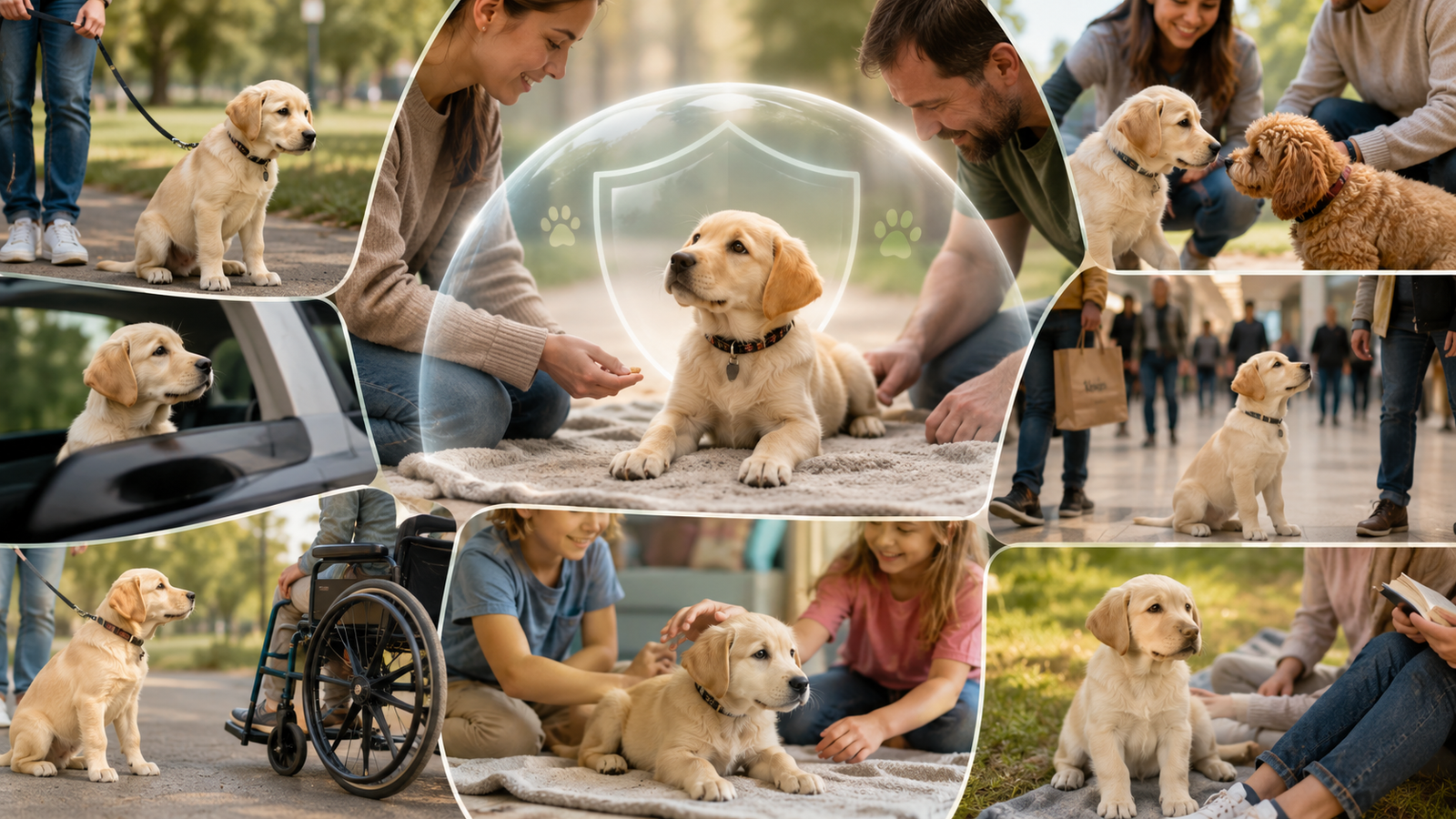
The foundational secret to safe, pre-vaccination socialization is a simple mechanical rule: Your puppy’s paws must never touch public soil, grass, or surfaces where unknown dogs have walked.
Parvovirus is an incredibly resilient pathogen shed in canine feces. It can survive in soil for years, enduring extreme freezing temperatures and blazing sunlight. It is easily picked up on a puppy’s paw pads and ingested when they lick themselves clean later.
Elevated exposure: keeping your Labrador puppy’s paws off public ground keeps them safe from viruses while allowing them to observe the world.. Fonte: AliExpress
A Step-by-Step System for Safe Pre-Vaccine Socialization
To systematically build a brave, resilient Labrador while maintaining strict viral safety protocols, implement this multi-layered exposure framework.
Maximize In-Home and Domestic Exposure
1.Maximize In-Home and Domestic Exposure:Weeks 8 to 10.
Before venturing out, introduce your puppy to unique stimuli within your controlled home environment. Walk them over crinkly plastic tarps, wire mesh grates, and bubble wrap laid across the living room floor to build surface confidence. Invite a diverse group of friends over—making sure they remove their shoes at the door—including people wearing hats, heavy winter coats, sunglasses, and high-visibility clothing.
2.Execute Elevated ‘Passenger’ Excursions:Weeks 9 to 12.
Place your Labrador puppy inside a secure dog backpack, a canvas tote bag, or a specialized puppy stroller and head to busy public locations. Stand outside bustling grocery stores, construction sites, and skate parks. Allow them to hear clanging shopping carts, shouting voices, and rolling wheels while feeding them high-value treats. If anyone approaches to pet them, they are welcome to do so, provided they sanitize their hands first.
3.Host Sanitized, Controlled Playdates:Weeks 10 to 14.
Your puppy needs to learn how to communicate with other dogs, but public dog parks are high-risk contagion zones. Instead, host private playdates in a fenced backyard belonging to a trusted friend. Ensure the helper dog is fully vaccinated, socially mature, and balanced. Avoid chaotic, unvaccinated “puppy parties” where behavioral trauma or viral cross-contamination can easily occur.
Sensory Checklist: The “Rule of 7” Exposure Goal
A phenomenal concept created by canine behavioral experts is the Rule of 7. By the time your Labrador puppy hits 12 weeks of age, they should ideally be exposed to seven different types of surfaces, objects, environments, and sounds.
Review this targeted sensory menu to track your progress:
Distinct Surfaces (Paws on Safe Ground Only)
- Polished hardwood and slick linoleum flooring
- Thick, wet grass and dry mulch in your private yard
- Crinkly aluminum foil and heavy plastic tarps
- Coarse gravel and smooth patio concrete
Novel Sights and Auditory Stimuli (Controlled Distance)
- Wound and Mechanical Noise: Sirens, vacuum cleaners, hair dryers, and lawnmowers played at low volumes initially.
- Wheeled Transport: Bicycles, skateboards, strollers, and delivery trucks driving past.
- Diverse Demographics: Children playing, tall individuals, people with umbrellas, and individuals utilizing mobility walkers or wheelchairs.
Frequently Asked Questions (FAQ)
Can my puppy attend a professional puppy socialization class before their final shots?
Yes, provided the facility follows strict safety protocols. High-quality puppy classes require proof of the first vaccine dose at least 7 days prior to entry, thoroughly sanitize the floors with veterinary-grade disinfectants before each session, and keep the classes small and highly supervised.
How do I know if my Labrador puppy is overwhelmed or stressed during exposure?
Watch for subtle canine stress signals: excessive yawning, rapid lip licking, a tucked tail, turning their head completely away from the stimulus, or pinning their ears backward. If your puppy refuses to take an exceptionally high-value treat like fresh chicken, their brain has slipped into panic mode. Immediately back away from the trigger until they calm down.
Is it safe to carry my puppy around a local pet supply store store?
It is safe only if you carry them the entire time or keep them inside a lined shopping cart. Never let them sniff or walk on the floor, as pet stores are frequent destinations for sick or unvaccinated dogs. Avoid the floor areas entirely to protect your puppy.
Conclusion: Crafting a Confident, Lifelong Companion
Socializing your Labrador puppy safely before their final round of vaccines requires focused mindfulness and proactive management, but it is entirely achievable. By prioritizing elevated visual exposure, hosting private playdates with trusted adult dogs, and treating human skin as an absolute barrier to public soil, you get the absolute best of both worlds.
You will successfully protect your puppy from the very real dangers of parvovirus while confidently building the emotional foundation your Labrador needs to become an unflappable, friendly, and well-adjusted adult dog.
What specific environmental trigger or sound seems to make your puppy nervous right now? Share your experiences below, and we can map out a gentle, gradual desensitization routine tailored precisely for your dog.