Bringing a new Labrador Retriever puppy into your home is an unforgettable milestone. You instantly fall in love with their velvety ears, their round bellies, and that clumsy, joyful tail wag that welcomes you every morning. But reality sets in quickly when you step barefoot onto a warm, wet spot on your living room rug for the third time in a single afternoon.
Suddenly, your dream of smooth puppy parenthood feels clouded by frustration. You find yourself constantly cleaning up messes, hovering over your puppy with anxiety, and wondering why they keep relieving themselves indoors just minutes after you brought them back inside.
If you are currently exhausted from cleaning your floors, take a deep breath: this is entirely fixable.
Labradors are highly cooperative, intelligent, and eager-to-please working dogs. Their cognitive capacity makes them one of the easiest breeds to housebreak on the planet. When potty training stalls, it is rarely a problem with the puppy’s intelligence; it is typically an issue of communication, inconsistent timing, or improper environmental management.
This definitive, veterinary-verified guide reveals exactly how to potty train a Labrador puppy fast. By understanding their physical bladder limits and applying this structured 5-step blueprint, you can stop indoor accidents and establish a clean, predictable household routine in record time.
The Biological Reality: Understanding Puppy Bladder Capacity
Before you can build a fast, effective housebreaking routine, you have to look at the physical limits of a young dog’s body. A common mistake is expecting a two-month-old puppy to hold their bladder for hours at a time. Physically, they simply cannot do it.
A reliable scientific rule of thumb for estimating an untrained puppy’s maximum physical bladder control timeline is the month-of-age metric:
$$\text{Maximum Bladder Hold Time (Hours)} = \text{Age of Puppy in Months}$$
For example, a 2-month-old (8-week-old) Labrador puppy can physically hold their urine for a maximum of 2 hours under ideal, resting conditions. However, when your puppy is awake, active, playing, or digesting food, this timeline drops drastically. To truly fast-track their training, you must act before they hit their physical limit, scheduling outdoor trips long before an emergency accident occurs.
How to Potty Train a Labrador Puppy Fast: The 5-Step Blueprint
This structured process replaces guesswork with a predictable, habit-forming sequence that teaches your Labrador puppy exactly where they need to go.
1. Establish a Strict, Time-Locked Routine
Puppy bodies thrive on biological predictability. If you feed, water, and walk your Labrador at the exact same times every day, their digestive tract will quickly synchronize to that schedule, allowing you to accurately predict when they need to eliminate.
The Featured Snippet Answer: To potty train a Labrador puppy fast, you must take them to a designated outdoor spot every 30 to 45 minutes during active hours, as well as immediately after they wake up from a nap, finish a meal, drink water, or wrap up a play session. Consistent, proactive transitions to the outdoors ensure you catch them before accidents can occur inside.
2. Implement the Crate Training Strategy
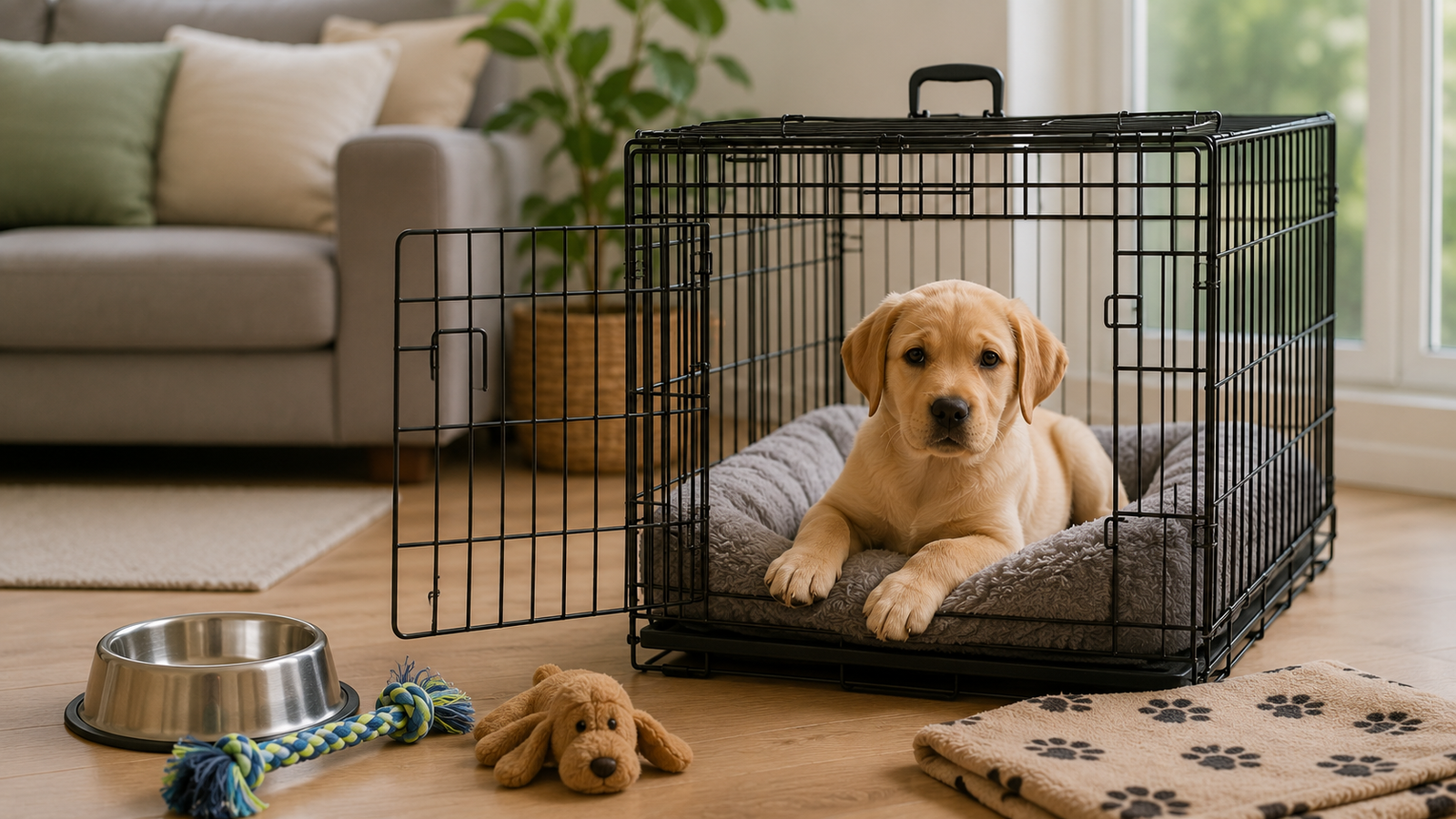
A training crate is not a tool for punishment; it is a vital structure that plays into your dog’s ancestral “den instinct.” Naturally, dogs work hard to keep their immediate sleeping quarters clean and dry.
- Sizing the Crate: The crate must be large enough for your Labrador puppy to stand up comfortably, turn around completely, and lie down flat. If the crate is too large, your puppy will simply use one side as a bedroom and the other side as a bathroom. Use a crate divider panel to increase the floor space gradually as your Labrador grows.
- The Transition Protocol: Whenever your puppy cannot be actively supervised by an adult, they should rest comfortably inside their crate. When you open the crate door to let them out, do not let them wander the house. Pick them up or guide them directly on a leash straight to their outdoor potty spot.
3. Designate and Label Your “Target Spot”
When you walk out your back door, do not let your puppy roam the entire yard to play. This blurs the line between play space and bathroom space.
- The Method: Guide your puppy on a short leash directly to a specific, designated patch of grass or mulch. Stand relatively still and ignore their attempts to play with your shoes.
- Add a Verbal Cue: The moment your puppy begins to eliminate, softly introduce a consistent verbal trigger phrase, such as “Go potty” or “Hurry up.” Over dozens of repetitions, your Labrador will build a strong associative link between that vocal command, the texture of that specific grass, and the physical act of relieving themselves.
4. Deploy High-Value, Immediate Reinforcement
Labradors are famously driven by food. To make them crave compliance, you must reward them with something far more enticing than standard dry kibble.
- The Reward Strategy: Keep a pouch of small, smelly, high-value rewards—like freeze-dried beef liver or tiny pieces of plain cooked chicken—right by your door.
- The Timing Window: You must deliver the reward within 3 seconds of completion. Do not wait until you walk back inside the kitchen to give them a treat, or they will assume they are being rewarded for walking through the doorway. Reward them right on the spot, accompanied by enthusiastic verbal praise.
5. Eradicate Indoor Accident Scents Completely
If your puppy has an accident indoors, your primary goal is to completely remove the lingering organic odors. If a puppy smells even a faint trace of their own urine signature on a rug, it triggers an instinctual prompt to reuse that exact spot as a regular bathroom area.
Never use standard household surface cleaners, ammonia-based solutions, or floor soaps to clean up puppy waste. Ammonia smells remarkably similar to the chemical components of urine, which can draw your puppy right back to the spot.
Instead, saturate the area completely with a specialized enzymatic pet stain and odor cleaner. The live enzymes in these formulas break down and consume the organic uric acid crystals at a molecular level, completely erasing the scent profile from your home.
Managing Your Puppy’s Potty Timeline
To help plan your day around your puppy’s physical development, refer to this baseline activity-based transition timeline:
| Puppy Activity Event | Required Housebreaking Action | Target Timing Window |
| Waking up from a nap | Transition immediately to outdoor potty spot | Within 60 seconds of eyes opening |
| Finishing a meal | Take outdoors immediately | Within 5 to 15 minutes of eating |
| Intense indoor playtime | Pause play and step outside | Every 15 to 20 minutes during activity |
| Unsupervised relaxation | Confine safely to a properly sized crate | Maximum duration matches age in months |
3 Critical Mistakes That Stall Potty Training Success
If your housebreaking progress feels stuck, check your routine for these three common missteps:
1. Rubbing a Puppy’s Nose in Their Mess
This is an outdated, harmful training myth. A puppy does not possess the abstract logic required to connect physical punishment with an accident that happened ten minutes ago. Punishing your puppy simply teaches them that you are unpredictable and dangerous when waste is present. This fear causes them to start hiding their messes, leading them to slip away behind couches or under beds to relieve themselves where you can’t see them.
2. Using Indoor Puppy Pee Pads
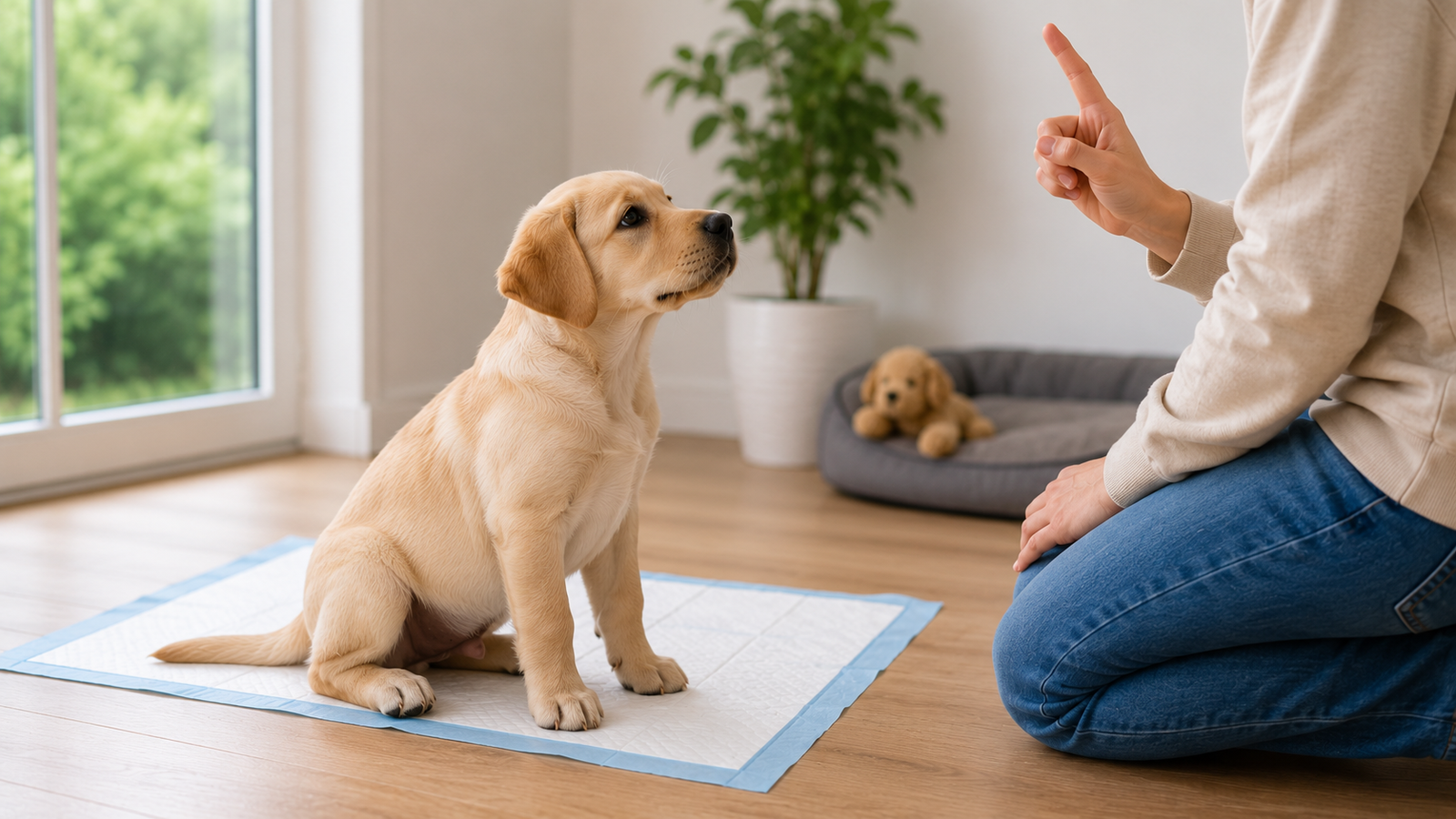
While puppy pads seem convenient, using them often slows down the housebreaking process. Training your puppy to use a pee pad actively teaches them that eliminating on a soft, flat fabric texture inside your home is an acceptable habit. Later, when you try to phase out the pads, your Labrador may struggle to distinguish between the pad, your rugs, or your bath mats. Skip the middle step and focus entirely on outdoor surfaces from day one.
3. Free-Feeding Food and Water
Leaving a full bowl of food or water out all day makes tracking your puppy’s digestive cycle nearly impossible. Instead, establish scheduled feeding times and remove the food bowl after 15 minutes. Provide fresh water throughout the day, but remove the water bowl roughly 2 hours before bedtime to give their bladder a chance to empty before the final night walk.
Frequently Asked Questions (FAQ)
What should I do if I catch my Labrador puppy actively peeing inside?
If you catch your puppy in the middle of an indoor accident, do not yell, clap aggressively, or scare them. Instead, calmly make a soft, clear sound (like “Oops!”) to pause their focus. Gently pick them up or guide them quickly out to their designated outdoor spot on a leash. If they finish eliminating outside, shower them with enthusiastic praise and reward them with a high-value treat to reinforce that the outdoor location is correct.
My Labrador puppy pees outside but then comes indoors and poops immediately. Why?
This usually happens because the puppy gets distracted by bugs, leaves, or outside noises while they are urinating. Once they finish emptying their bladder, they forget about their need to defecate until they return to the quiet, calm environment inside your home. To prevent this, keep your puppy on a leash outside and stay at their designated potty spot for at least 5 to 10 minutes after they pee, giving their bowels time to move naturally.
At what age should a Labrador puppy be fully, reliably housebroken?
With a consistent routine and proactive crate training, most Labrador puppies can achieve excellent daytime bladder control by 4 to 6 months of age. However, minor regressions can happen during developmental milestones or teething phases. A dog is typically considered fully, reliably housebroken once they have gone two consecutive months without a single indoor accident.
Conclusion: Consistency Yields Results
Potty training your Labrador puppy fast doesn’t require complex strategies or intense discipline. It simply requires you to be consistent, clear, and proactive. By setting a reliable schedule, utilizing a crate properly, rewarding them for outdoor successes, and completely cleaning up indoor accidents with an enzymatic solution, you provide your puppy with a clear, stress-free path to success. Stay patient, stay positive, and remember that every outdoor success brings you one step closer to a clean home and a well-trained adult companion!
How old is your Labrador puppy right now, and which room in your home is their biggest challenge spot for accidents? Let us know your stories or ask your questions in the comments below!