We love our Labrador Retrievers for their boundless joy, their unyielding loyalty, and yes, even their absolute obsession with food. There is something incredibly heartwarming about watching a Lab wiggle with pure delight at the mere sound of a kibble bag opening. Because they bring us so much happiness, it is incredibly easy to show them love back through a few extra treats, a scoop of peanut butter, or a little scrap from the dinner table.
But over time, those small, well-intentioned gestures can add up in a way that quietly threatens your dog’s health.
You might look down at your companion one day and notice that their athletic, tapered waistline has softened into a gentle, round shape. You might find yourself wondering: Is my Labrador just carrying a little extra fluff, or are they genuinely overweight?
This is a critical moment. Labrador obesity isn’t just a cosmetic concern—it is a serious medical issue. Because of their heavy frames and genetic tendencies, carrying excess body fat dramatically accelerates painful joint damage and can significantly shorten your dog’s life.
The good news is that you have full control over the solution. This expert, science-backed guide provides 5 easy ways to check if your Labrador is overweight right now, explains the biology behind their constant hunger, and gives you a step-by-step blueprint to kickstart a safe, highly effective weight loss diet.
The Biological Reality: Why Labradors Lose the Weight War
Before assessing your dog’s shape, it helps to understand that your Labrador isn’t overeating out of defiance or bad behavior. They are fighting against their own genetics.
As clinical veterinary studies have confirmed, a high percentage of Labradors carry a genetic deletion mutation in their POMC (pro-opiomelanocortin) gene. This specific gene acts as the body’s internal switch to signal fullness and satiety after a meal.
Without a fully functioning POMC gene, an overweight Labrador lives in a permanent state of perceived hunger. Their brain is constantly sending an urgent signal to find and consume calories. When you combine this relentless biological drive with a modern, sedentary lifestyle, weight gain is almost inevitable unless you step in with precise portion management.
Is Your Labrador Overweight? 5 Easy Ways to Check Right Now
You cannot rely on the bathroom scale alone to determine if your dog is healthy. A large “English style” show Lab might weigh 85 pounds and look perfectly balanced, while a lean “American style” field Lab at the same weight could be significantly obese.
Instead, utilize these five hands-on, visual evaluation methods used by veterinarians worldwide:
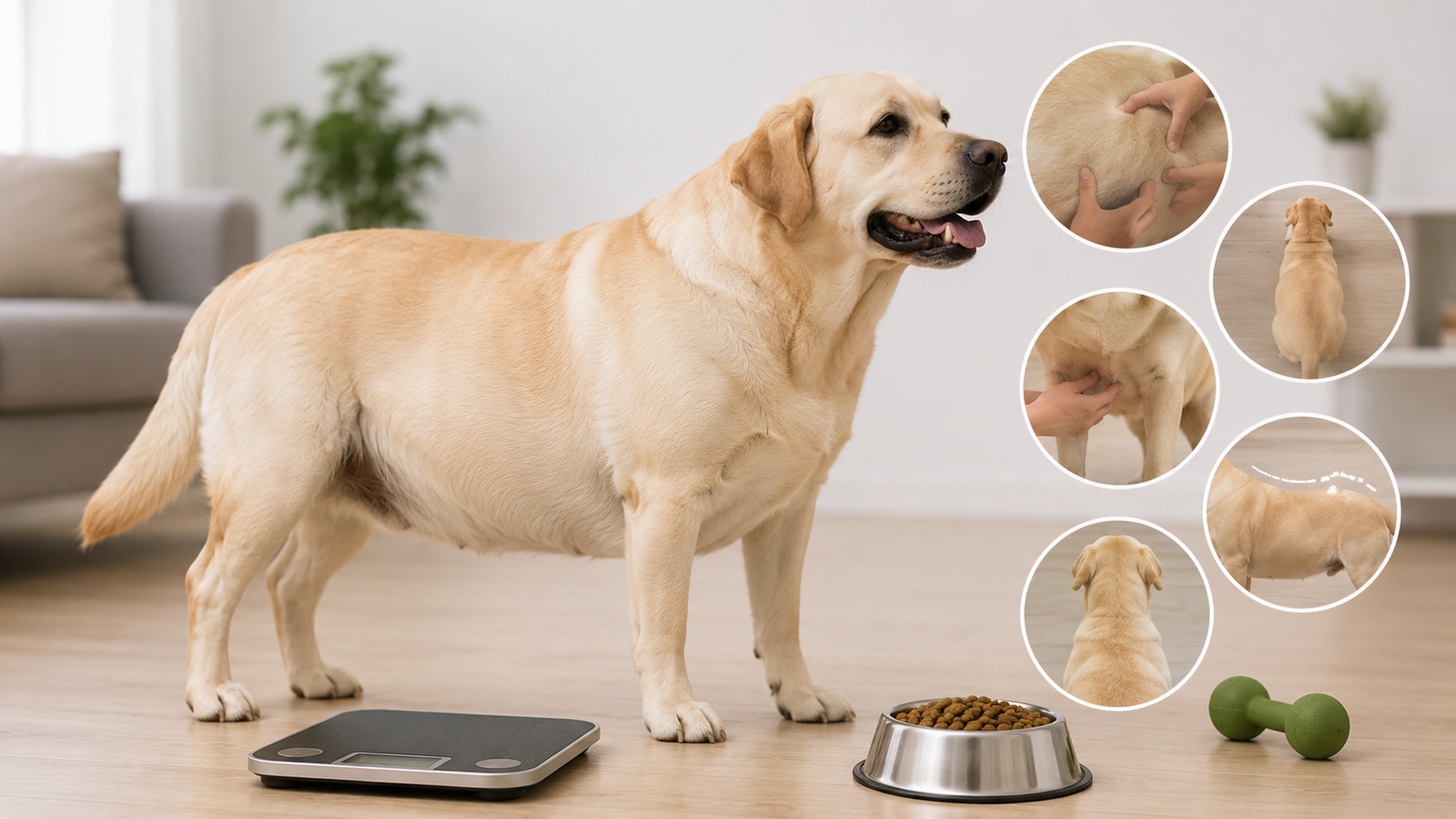
1. The “Knuckle Test” Rib Check
Your Labrador’s ribs are the most accurate physical indicator of their body fat percentage.
- How to do it: Place both hands flat against the side of your Lab’s ribcage and gently run your palms back toward their hind legs.
- The Check: Make a fist with your own hand and feel your knuckles. If your Lab’s ribs feel like the knuckles on the back of your hand, they are too thin. Now, turn your hand over and feel your palms directly under your fingers. If your Lab’s ribs feel smooth and flat like your palm, meaning you have to press firmly inward just to locate a bone, your Labrador is overweight. Ideally, their ribs should feel exactly like the knuckles on an open, flat hand—easily felt under a thin layer of skin.
2. The Visual Overhead Waist Evaluation
Stand directly above your Labrador while they are standing up straight on all four paws, and look down at their silhouette from above.
- What to look for: An ideal Labrador should display an hourglass shape. Their body should widen at the ribcage, taper inward significantly behind their ribs to form a distinct waist, and then widen again slightly at the hips. If their sides run completely straight from the shoulders back to the hips, or if their body curves outward like an oval or a lightbulb, your Lab is carrying an unsafe amount of abdominal fat.
3. The Side-Profile Abdominal Tuck Check
Crouch down next to your dog so you are eye-level with their profile, and look at the line of their belly where it meets their hind legs.
- What to look for: A healthy Labrador must display a distinct upward slant, known as an abdominal tuck. The lowest point of their chest should gently slope upward into a narrower waistline before reaching their thighs. If their belly line runs completely parallel to the floor, or if their abdomen sags downward toward the ground, they have lost their structural tuck and require immediate dietary adjustment.
4. The Tail-Base and Spinal Examination
Run your fingers firmly down your Labrador’s spine, moving from the base of their neck all the way out to the start of their tail.
- What to look for: You should be able to easily identify the individual ridges of their spinal column and the prominent pelvic bones near the base of their tail under a light layer of tissue. If these skeletal landmarks are completely buried beneath a thick, squishy pillow of fat, or if your Lab has developed a dimple or a “flat shelf” of fat directly above the base of their tail, their body fat percentage has climbed into the danger zone.
5. The Mobility and Stamina Behavioral Tracking
Sometimes the clearest signs are behavioral rather than visual. Take a close look at how your Labrador moves during everyday activities.
- What to look for: Does your dog struggle or hesitate before pushing themselves up from a sleeping position on the floor? Do they pant heavily after a simple, brief walk around the block? If your Lab sits down frequently during playtime or clears their throat with a heavy sigh whenever they exert themselves, the extra physical weight is actively stressing their cardiorespiratory system and wearing down their joints.
How to Set Up a Safe, Successful Weight Loss Diet
If your checking confirms your Labrador is carrying extra weight, don’t worry. You can fix this. However, you must avoid extreme “crash diets,” which can cause your dog to lose lean muscle mass instead of fat, or leave them dangerously malnourished.
Follow this structured, step-by-step plan to guide your Lab back to a healthy weight safely:
Step 1: Establish Your Target Calorie Deficit
To trigger steady fat loss, you must calculate a specific calorie target based on your Labrador’s ideal target weight, not their current overweight weight.
The Snippet Answer: To help an overweight Labrador lose weight safely, you should establish a controlled calorie deficit. First, calculate your dog’s baseline Resting Energy Requirement (RER) for their ideal goal weight using the formula
$$RER = 70 \times (\text{Ideal Weight in kg})^{0.75}$$
. To achieve a safe, steady weight loss rate of 1% to 2% of their body weight per week, multiply this target RER by a weight-loss lifestyle factor of 1.0 to 1.2 to determine their total daily allowed calories.
Step 2: Weigh Every Meal Using a Gram Scale
Do not rely on plastic measuring cups, as a slight variation in your scoop can easily add 10% more calories than intended. Look at the exact calorie density listed on your dog food bag (written as kcal/kg or kcal/cup), and use a digital kitchen scale to weigh out their food down to the exact gram for every meal.
Step 3: Use Healthy, Low-Calorie Fillers
Because your Lab’s POMC gene mutation will leave them feeling incredibly hungry during a calorie deficit, you can prevent persistent begging by adding high-volume, low-calorie “fillers” to their bowl.
Replace 10% of their calculated kibble portion with plain, steamed green beans, unsalted canned pumpkin, or sliced cucumbers. These vegetables add excellent fiber and moisture, filling up their stomach mechanically and helping them feel satisfied without adding a dangerous amount of extra calories.
Step 4: Switch to Non-Weight-Bearing Exercise
Do not force an obese Labrador to engage in high-impact running or intense fetching sessions on hard pavement to burn calories. This extra impact can easily tear their cranial cruciate ligaments (CCL) or accelerate painful arthritis.
Instead, focus on low-impact swimming or controlled walks on soft grass. Swimming provides an incredible cardiovascular workout that burns calories efficiently while completely removing all weight and pressure from their aching joints.
Frequently Asked Questions (FAQ)
How much weight can an adult Labrador safely lose each week?
A safe, healthy weight loss rate for an adult Labrador is 1% to 2% of their total body weight per week. For a 80-pound Labrador aiming to slim down, this means a steady loss of roughly 0.8 to 1.6 pounds per week is ideal. Losing weight too quickly can deplete their essential muscle tissues and cause metabolic imbalances, so steady, gradual progress is the safest goal.
Can I just feed my overweight Labrador less of their regular adult kibble?
While you can simply reduce their current food portions, cutting their standard kibble by more than 20% can inadvertently reduce their daily intake of essential vitamins, minerals, and amino acids. If your Lab requires a significant reduction to lose weight, it is often safer to gradually transition them to a specialized veterinary “Weight Management” or “Light” formula. These diets are specifically designed to have lower calorie densities while maintaining robust, highly concentrated micronutrient profiles.
Are there any underlying medical issues that cause Labradors to gain weight?
Yes. If your Labrador is gaining weight consistently despite strict calorie tracking and portion control, schedule a veterinary checkup. Conditions such as hypothyroidism (an underactive thyroid gland) or Cushing’s disease (hyperadrenocorticism) can severely depress your dog’s baseline metabolic rate, making weight loss nearly impossible until the underlying hormonal issue is medically managed.
Conclusion: The Ultimate Gift of Health
Managing your Labrador’s weight can be a challenging journey, especially when you have to look past those expert begging routines twice a day. But keeping your best friend lean and fit is one of the single most powerful things you can do to protect their health. By using our five easy checks, using a digital scale, and introducing healthy, low-calorie fillers, you aren’t depriving your Lab—you are directly relieving pressure on their joints, protecting their heart, and gifting them more comfortable, vibrant years by your side.
Have you tried the knuckle test on your Labrador yet, and what score do you think they land on? Share your results or ask a question in the comments below!