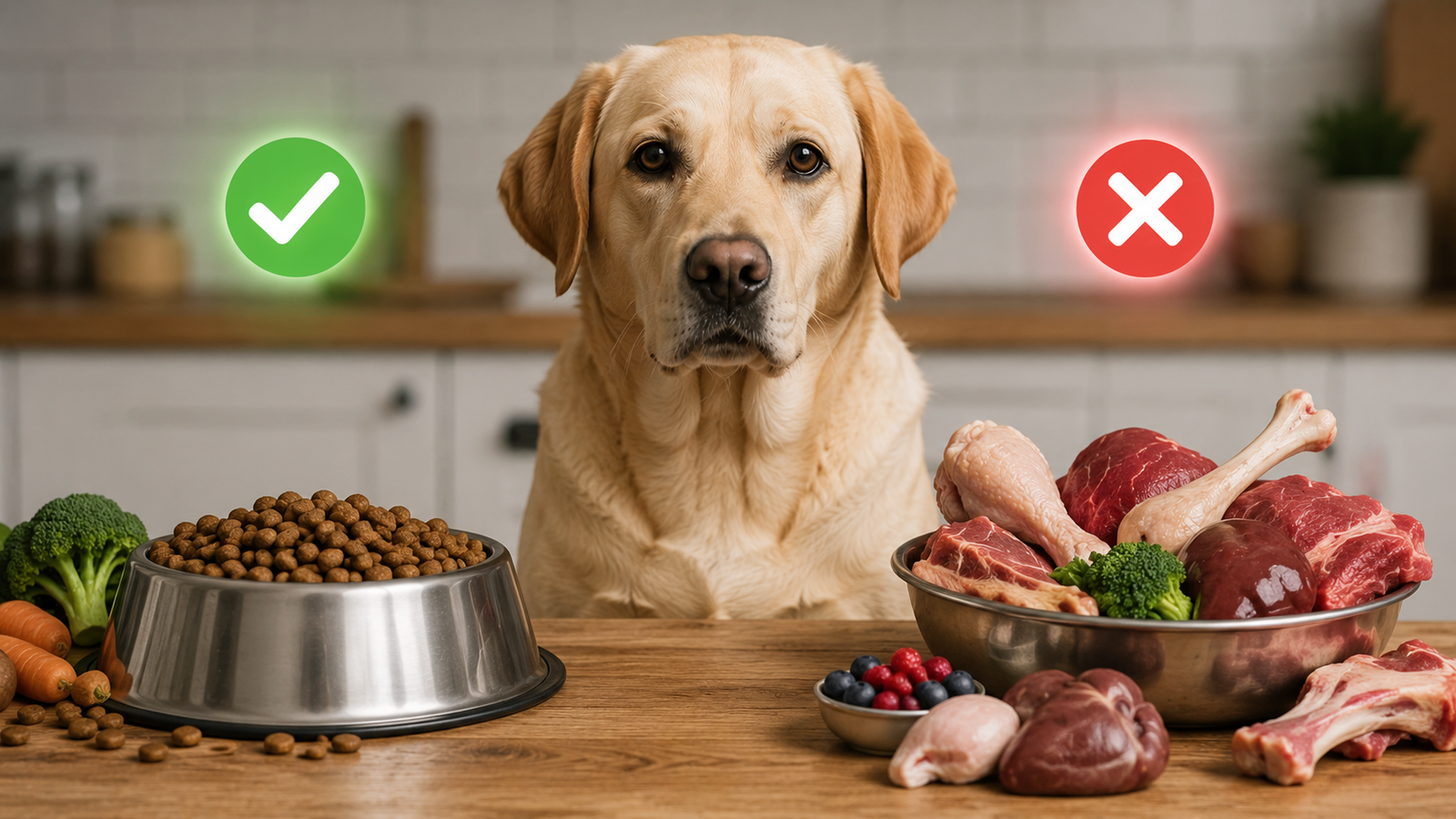
If you live with a Labrador Retriever, you are intimately familiar with “The Look.” It happens twice a day, every single day. Your dog sits by their food bowl, staring at you with a mix of desperate longing and deep heartbreak, as if they haven’t eaten a single morsel of food since the turn of the century.
Because Labradors possess an almost bottomless appetite, you can never rely on their behavior to tell you when they are full. If left to their own devices, most Labradors would happily eat until they physically made themselves sick.
As a responsible owner, this leaves you holding a heavy responsibility. Every scoop of food you drop into that bowl directly impacts your dog’s long-term health, joint mobility, and overall lifespan.
Feed them too little, and you risk leaving your active companion malnourished. Feed them just a tiny bit too much over a few months, and you will quickly see their waistline disappear, placing an unsafe burden on their hips and elbows.
So, how do you solve the ultimate canine mystery? How do you look past those begging brown eyes and determine exactly how much an adult Labrador should eat daily?
The answer isn’t found on a generic pet food bag instruction label. It requires a precise combination of biological math, lifestyle evaluation, and structural weight tracking. This definitive guide delivers the exact veterinary equations, food charts, and portion strategies needed to keep your adult Labrador perfectly fueled, lean, and thriving.
The Short Answer: A General Baseline
If you are looking for a quick, foundational baseline, here is the standard starting point used by most pet parents.
The Quick Answer: On average, a healthy, typically active adult Labrador Retriever weighing between 60 to 80 pounds requires roughly 2 to 3.5 cups of high-quality dry kibble per day, split into two separate meals.
However, relying entirely on “cups” as a standard unit of measurement is highly inaccurate. A cup of high-calorie, active performance food can contain up to 500 calories, whereas a cup of standard weight management kibble might provide only 300 calories.
To prevent obesity and maximize your Lab’s lifespan, you must move past cups and learn to measure their food based on kilocalories (kcal).
The Veterinary Math: Calculating Your Lab’s Exact Daily Calorie Needs
Veterinary nutritionists do not guess food portions; they calculate them using your dog’s specific body weight and activity level. You can use this exact same scientific protocol at home to find your Labrador’s target intake.
Step 1: Calculate the Resting Energy Requirement (RER)
The Resting Energy Requirement (RER) is the exact number of calories your Labrador’s body needs to perform basic, vital life functions—like breathing, circulating blood, and digesting food—while resting completely still in a temperature-neutral room.
To find your dog’s RER, convert their current weight from pounds to kilograms (divide the weight in pounds by 2.2), and apply the standard veterinary metabolic formula:
$$RER = 70 \times (Weight\ in\ kg)^{0.75}$$
For an average 70-pound (31.8 kg) adult Labrador, the math looks like this:
$$RER = 70 \times (31.8)^{0.75} \approx 937\ kcal\ \text{per day}$$
Step 2: Apply the Lifestyle Factor to Find Total Daily Energy Requirement (DER)
Once you have the baseline RER, you must multiply it by a specific lifestyle coefficient to determine their true Daily Energy Requirement (DER). This takes into account whether your Lab is a lazy couch potato, an intact adult, or a highly active working companion.
| Labrador Lifestyle Profile | Metabolic Coefficient | Example (70 lb Lab Daily Needs) |
| Neutered / Spayed (Typical House Pet) | $1.6 \times RER$ | 1,500 kcal / day |
| Intact Adult (Not Sterilized) | $1.8 \times RER$ | 1,686 kcal / day |
| Prone to Weight Gain (Lazy / Senior) | $1.2 \text{ to } 1.4 \times RER$ | 1,124 to 1,311 kcal / day |
| Working / Hunting Field Lab | $2.0 \text{ to } 3.0 \times RER$ | 1,874 to 2,811 kcal / day |
The Adult Labrador Feeding Chart by Weight
To make this daily management simple, use the feeding chart below. It matches common adult Labrador target weights with average daily calorie targets and approximate kibble amounts (assuming a standard kibble density of 400 kcal per cup):
The Hidden Trap: Why Labradors Require Strict Portion Control
Why can’t you just trust your Labrador to self-regulate, like some other dog breeds do? The answer is a fascinating mix of evolutionary survival strategies and genetics.
As mentioned in our nutritional guides, a significant percentage of Labradors carry a deletion mutation in their POMC (pro-opiomelanocortin) gene. This specific gene is responsible for signaling to the brain that the body has consumed enough food and is full.
Because this internal switch is missing or altered, your Labrador is trapped in a biological state of perceived starvation. Their brain is constantly telling them to gather and consume as many calories as possible.
If you give in to their dramatic begging behaviors and overfill their bowl, you actively trigger a metabolic cascade that can significantly shorten their life. Obesity in Labradors contributes directly to the rapid onset of severe osteoarthritis, strains vital heart tissues, and increases their risk of developing chronic metabolic conditions like diabetes.
4 Rules for Managing Your Labrador’s Daily Food
To ensure your adult Labrador gets the exact amount of nutrition they need without gaining unwanted weight, follow these four daily rules:
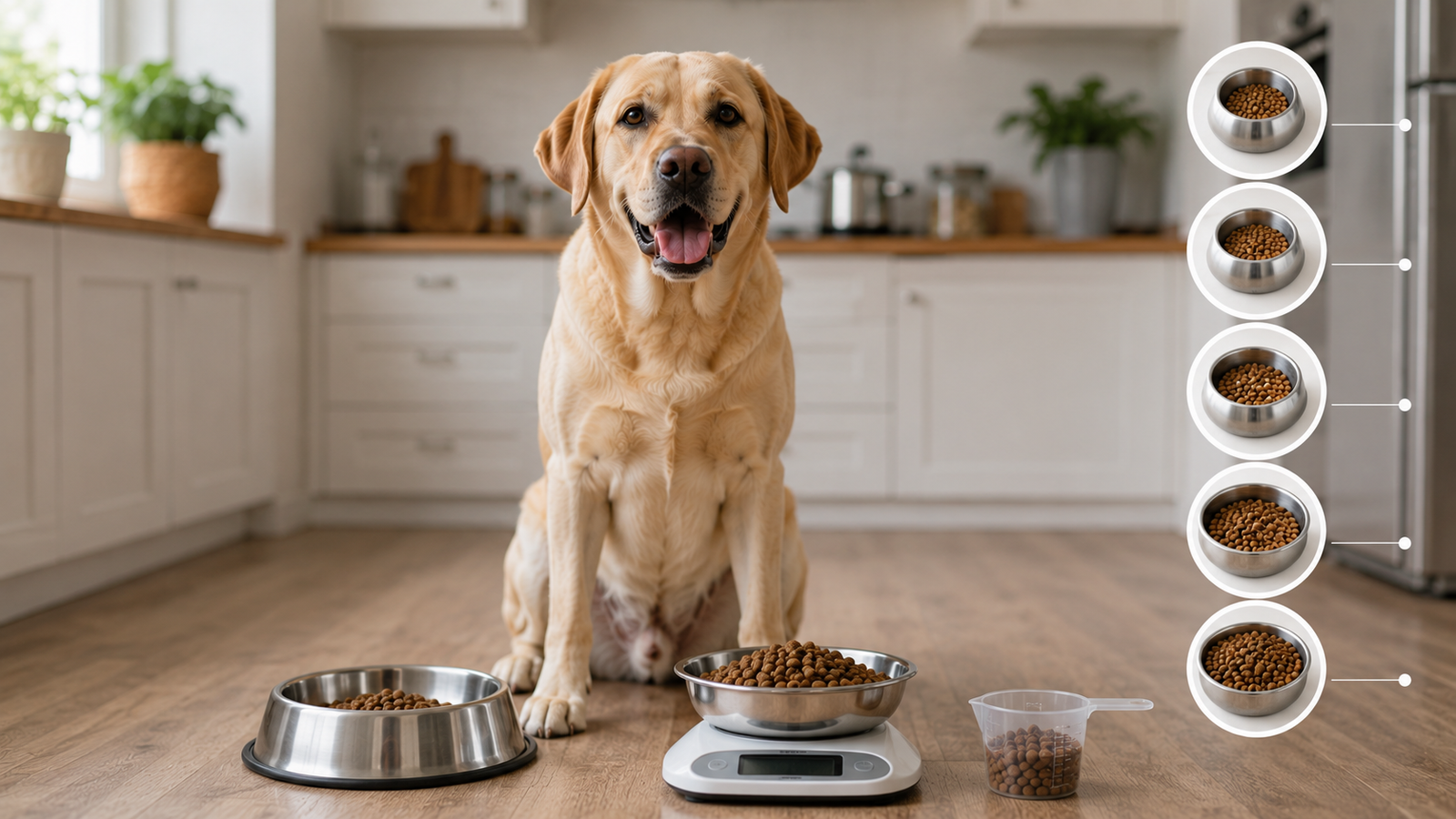
1. Always Weigh Your Food on a Digital Scale
Throw away the plastic measuring cup. Scooping food by eye is highly inaccurate; a slight dome on top of a cup scoop can easily add 50 hidden calories to each meal. Over a week, that oversight can add up to an entire extra day’s worth of food.
Place a digital kitchen scale on your counter, check the calorie density on your dog food bag (usually written as kcal/kg), and weigh out the exact number of grams required for each meal.
2. Enforce the 10% Treat Boundary
Every cookie, training reward, piece of fruit, or leftover scrape of meat you give your Labrador contains calories that count toward their daily total.
Treats and snacks must never make up more than 10% of your Lab’s total daily allowed calories. If you give your dog 150 calories worth of training treats during the day, you must deduct those 150 calories directly from their evening food bowl to keep their overall intake balanced.
3. Split Their Daily Intake Into Two Separate Meals
Never feed an adult Labrador their entire daily portion of food in a single feeding. As detailed in our guide on why Labradors are prone to bloat, loading a large, deep chest with a massive volume of dry kibble all at once can cause the stomach to swell and twist, triggering a life-threatening case of Gastric Dilatational-Volvulus (GDV). Divide their calculated daily allowance into two equal portions, spaced roughly 12 hours apart.
4. Monitor Their Silhouette, Not Just the Scale
Muscle is denser than fat, meaning a muscular, working field Labrador might weigh 75 pounds and look incredibly lean, while a sedentary show-line Labrador might weigh 75 pounds and carry far too much body fat.
Evaluate your dog weekly using the Canine Body Condition Score (BCS). You should be able to easily feel their ribs with light pressure, and they must show a clear, visible waistline when viewed from directly above. If their waist starts to fill out and disappear, decrease their daily calorie intake by 10%, regardless of what the feeding chart says.
Frequently Asked Questions (FAQ)
Should I change how much I feed my Labrador during the winter?
Yes, depending on their living environment and daily activity level. If your Labrador is a working outdoor dog or spends hours running in the snow, their body burns significantly more calories just to maintain a stable internal body temperature, meaning they may require a 10% to 20% increase in food. However, if your Lab is an indoor family pet who spends cold winter days sleeping on the couch, you should actually decrease their portions slightly to account for their lower seasonal activity.
My Labrador is always acting starved. How can I add volume to their bowl without adding calories?
To satisfy your Lab’s instinctual desire to eat a larger volume of food without causing weight gain, you can use healthy, low-calorie “fillers.” Adding raw green beans, steamed broccoli, or pure canned pumpkin (not pumpkin pie mix) to their bowl adds excellent dietary fiber and moisture. This fills up their stomach and helps them feel satisfied without adding a dangerous amount of extra calories.
How do I know if I need to switch my Labrador to a weight-management diet?
If you have reduced your Labrador’s daily food portions to the absolute minimum recommendation for their weight class and they still struggle to maintain a distinct waistline, schedule a veterinary visit. Your vet can check for underlying metabolic conditions like hypothyroidism. If your dog gets a clean bill of health, switching to a specialized “Weight Management” or “Light” kibble can help, as these formulas use higher fiber contents to keep them full on fewer calories.
Conclusion: You Are the Guardian of the Bowl
Your Labrador Retriever looks to you for everything, and they trust you completely to manage their health. While their dramatic begging routines might make you feel guilty, keeping their daily food portions precisely managed is one of the greatest acts of love you can provide. By doing the calorie math, weighing their meals on a digital scale, and tracking their body shape, you can keep them lean, protect their joints, and ensure you enjoy many happy, energetic years together.
How many cups or grams of food does your adult Labrador eat each day, and how do you handle their begging routines? Share your feeding strategies or questions in the comments below!