You have just returned from a grueling, three-mile run with your Labrador Retriever. You sink into your favorite armchair, completely exhausted, looking forward to a quiet evening. Then, you look down. Your Lab is standing right in front of you, a tennis ball clamped firmly in their jaws, their tail wagging at supersonic speed, their eyes gleaming with relentless, unspent energy.
Your heart sinks slightly. You wonder: How is this physically possible? What does it take to actually tire out this dog?
If you are a Labrador owner, this scenario is a regular part of your life. Labradors are elite sporting and working dogs, genetically engineered for extreme physical stamina and intense problem-solving. But here is the secret that many dog owners overlook: physical exercise alone will not tire out a Labrador.
In fact, focusing solely on longer runs or endless fetch sessions simply turns your dog into an elite marathon runner with a world-class cardiovascular system. If you want to transform a hyperactive, destructive, or restless Lab into a calm, satisfied companion, you must work their brain.
Mental exhaustion triggers a deeper, cleaner state of rest than physical fatigue alone. This guide reveals 5 high-energy mental stimulation games designed to tap into your Labrador’s working heritage, burn their excess adrenaline, and provide deep cognitive fulfillment.
The Canine Science: Why Mental Enrichment Beats Endless Running
To understand why brain games are so effective, we must look at the caloric and neurological demands of canine cognitive processing. A dog’s brain possesses a massive olfactory cortex—the region dedicated to processing scents—which contains roughly 300 million olfactory receptors compared to a human’s meager 6 million.
When a Labrador actively solves a complex puzzle or uses their nose to track a hidden target, their brain fires at maximum capacity. This intense concentration elevates their heart rate, burns glucose, and consumes significant mental energy.
Neurobiological research indicates that 15 minutes of structured mental stimulation can tire a dog out more effectively than an hour of repetitive physical running. By incorporating games that channel their natural hunting, retrieving, and tracking instincts, you fulfill their genetic drives without overworking their joints.
5 High-Energy Mental Stimulation Games for Labradors
These activities blend physical movement with deep cognitive challenges to maximize energy output.
The Featured Snippet Answer: The 5 best high-energy mental stimulation games for Labrador Retrievers are The Advanced Scent Trail Game, The Speed-Retrieval Name Game, The Flirt Pole Impulse Control Challenge, The Triple-Cup Shell Game, and The Urban Agility Obstacle Course. These activities combine physical exertion with critical cognitive tasks—like scent tracking, vocabulary discrimination, and impulse control—to tire out a hyperactive dog fast.
1. The Advanced Scent Trail Game (The “Find It” Mission)
Labradors possess a world-class scenting heritage. This game transforms your living room or backyard into a complex tracking field, forcing them to hunt down a hidden prize using their nose rather than their eyes.
- The Setup: Confine your Labrador to a separate room or crate where they cannot watch you. Take a highly aromatic reward—like a piece of dried fish, hot dog slivers, or freeze-dried liver—and drag it along the floorboards or grass to create a physical scent trail. Hide the jackpot reward behind a door or inside an open box at the end of the line.
- The Execution: Release your Labrador and give them a specific search command, like “Find it!” Encourage them to drop their nose to the ground.
- The Benefit: Watching a Lab work a scent trail reveals pure genetic hardwiring in action. The intense focus and rapid sniffing lower their blood pressure while channeling their ancestral hunting drive into a constructive task.
2. The Speed-Retrieval Name Game (Vocabulary Discrimination)
Your Labrador already loves to fetch, but standard fetch requires almost zero brainpower. By adding vocabulary discrimination, you transform a simple physical game into an advanced cognitive challenge.
- The Setup: Gather three distinct toys that your Labrador values highly—for example, a rubber ball, a plush duck, and a rope toy. Give each item a clear, distinct name (e.g., “Ball,” “Duck,” “Rope”).
- The Execution: Line the three toys up side-by-side on the ground. Sit five feet away with your Labrador in a seated stay. Look directly at them and give a specific command: “Bring the Duck.”
- The Progression: If they pick up the duck, deliver enthusiastic praise and a high-value treat. If they pick up the wrong item, gently say “Oops,” take the toy away, and reset. As they master the names, increase the physical distance by tossing the items into deep grass, forcing them to scan, remember, and identify the correct object under physical exertion.
3. The Flirt Pole Impulse Control Challenge
A flirt pole is essentially a giant cat wand designed for large dogs—a long, sturdy rod attached to a durable rope with a fleece lure tied to the end. It is one of the most efficient tools for burning physical and mental energy simultaneously.
- The Protocol: Ask your Labrador to sit and stay. Begin lashing the flirt pole lure across the ground in rapid, erratic circles to mimic moving prey. Your Lab must remain firmly seated despite their intense instinct to chase.
- The Release: Once they demonstrate a few seconds of solid focus, deliver your release cue (e.g., “Okay!”). They can then launch into an explosive chase to catch the lure.
- The Value: This game targets impulse control. Forcing a high-drive sporting dog to consciously brake their own physical impulses while their adrenaline is pumping is an incredible mental workout that builds deep emotional self-regulation.
4. The Triple-Cup Shell Game (Problem Solving)
This classic game tests and expands your Labrador’s object permanence, visual tracking, and cognitive reasoning skills.
- The Setup: Place three identical, opaque plastic cups upside down on the floor in front of your dog.
- The Execution: Show your Labrador a high-value treat, place it openly under one of the cups, and mix the cups around slowly. Give your search command. Your Lab must point to, nudge, or paw the correct cup to reveal the treat.
- The Scaling: Once they understand the mechanics, pick up the pace and cross the cups over more rapidly. This forces them to focus entirely on visual tracking, building spatial awareness and focus.
5. The Urban Agility Obstacle Course (Proprioception)
You do not need an expensive, professional agility course to challenge your dog’s spatial awareness and coordination. You can easily build a highly effective course using standard household furniture.
- The Setup: Arrange a row of sturdy kitchen chairs to weave through, a large cardboard box open on both ends to act as a tunnel, and a broomstick balanced across two stacks of books to create a low jump.
- The Execution: Guide your Labrador through the course using a treat as a lure, introducing specific verbal commands for each station (e.g., “Weave,” “Tunnel,” “Jump”).
- The Benefit: Large breeds like Labradors often lack a clear awareness of where their hind legs are in space (a concept known as proprioception). Navigating tight boundaries, balancing on uneven surfaces, and adjusting their balance requires intense cognitive concentration and physical stabilization.
The Ultimate Mental Stimulation Routine
To keep your Labrador’s mind sharp without overstimulating them, aim for a balanced mix of games throughout the week:
| Game Type | Primary Core Cognitive Skill | Recommended Duration | Optimal Weekly Frequency |
| Advanced Scent Trail | Olfactory processing & focus | 10 to 15 Minutes | 3 Times per week |
| Speed-Retrieval Name Game | Vocabulary discrimination | 10 Minutes | 2 Times per week |
| Flirt Pole Challenge | High-adrenaline impulse control | 5 to 10 Minutes | 2 Times per week |
| Triple-Cup Shell Game | Visual tracking & reasoning | 5 Minutes | Daily as a warm-up |
| Urban Agility Course | Proprioception & body coordination | 15 Minutes | 1 Time per week |
3 Pitfalls to Avoid in Canine Cognitive Enrichment
When introducing brain games to a high-energy dog, keep these three structural guidelines in mind:
1. Setting the Difficulty Level Too High
If you make a puzzle or a scent trail too difficult on the first attempt, your Labrador may quickly become frustrated, lose interest, or give up entirely. Always start with incredibly easy wins. When playing the scent trail game, let them watch you hide the treat the first few times. Once they understand the basic rules of the game, you can gradually increase the difficulty to keep them engaged.
2. Using Low-Value Rewards
Mental stimulation requires deep focus, and deep focus demands a strong incentive. Standard dry kibble rarely offers enough motivation to keep a distracted dog engaged. For brain games, always use high-value, small, and aromatic rewards—such as small pieces of cheese, freeze-dried liver, or plain cooked chicken breast—to keep their motivation high.
3. Letting the Game Overheat Their Adrenaline
Games like the flirt pole can push a dog’s adrenaline levels dangerously high. If your Labrador starts barking frantically, growling aggressively at the lure, or ignoring your commands completely, the game must stop immediately. A brain game should always emphasize focus and control, not wild overstimulation. Always end each session on a calm, successful note before your dog crosses the line into frantic behavior.
Frequently Asked Questions (FAQ)
Can mental stimulation games replace my Labrador’s daily walks?
No. Mental stimulation should be used to complement, not replace, their daily physical exercise. Labradors still need outdoor walks to stretch their muscles, explore new environments, and socialize. Think of brain games as an extra tool to burn off the stubborn remaining energy that a standard walk leaves behind.
My Labrador gets frustrated and tries to chew up puzzle toys. How do I stop this?
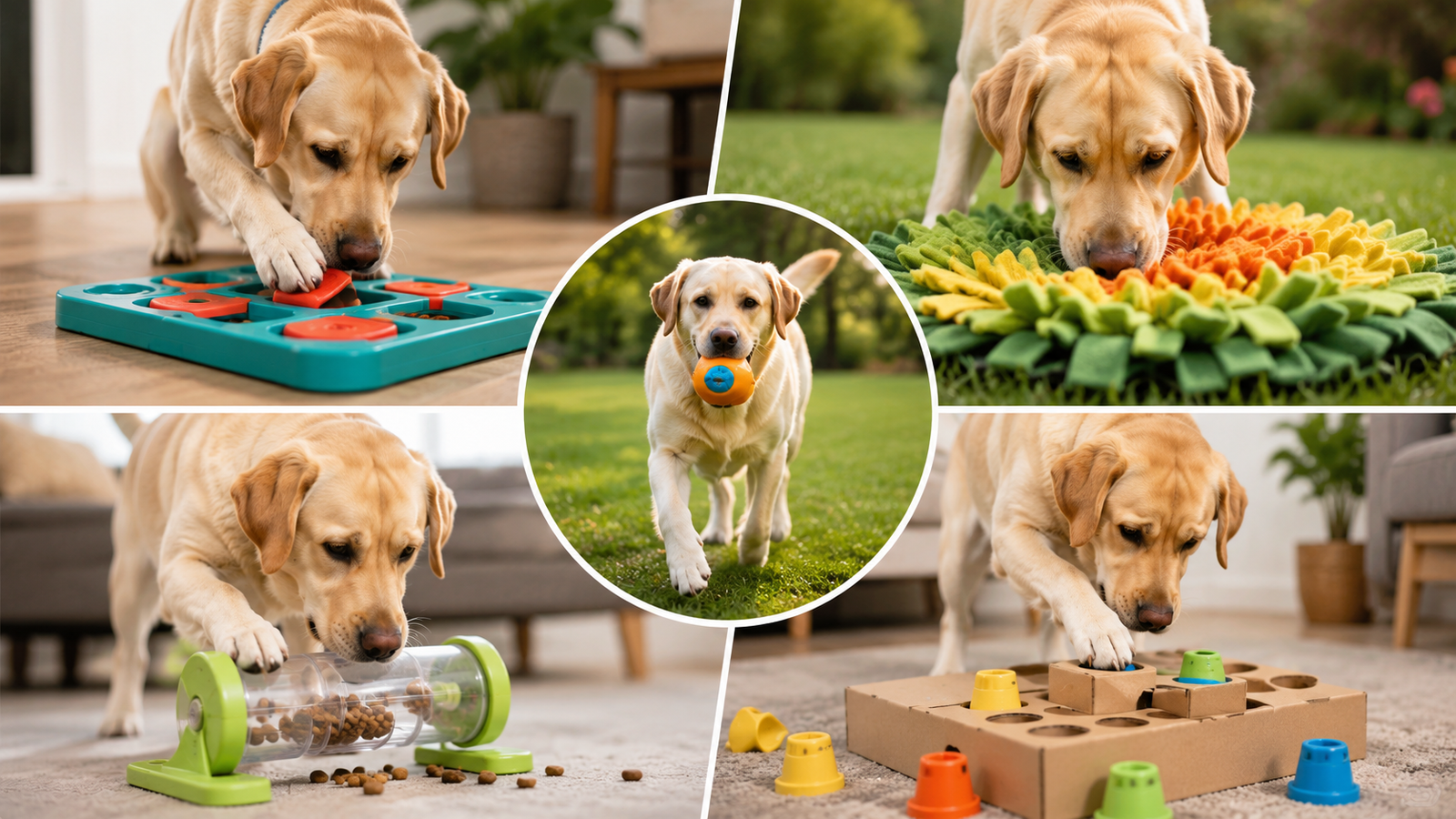
This is a very common issue with food-motivated breeds like Labradors. If a puzzle toy doesn’t open fast enough, they will often try to smash, bite, or chew through it to reach the food inside. If you see your dog biting a puzzle, immediately intervene, ask for a brief pause or a sit, and show them how the mechanism slides or opens. This helps guide them back to using their brain rather than brute force.
Are these mental stimulation games safe for senior Labradors with arthritis?
Yes! In fact, brain games are excellent for aging or arthritic Labradors. As dogs grow older, their physical bodies can no longer handle intense running or long games of fetch, but their minds remain sharp. Low-impact activities like the scent trail or the shell game provide great mental exercise, keeping your senior companion happy and tired without putting any stress on their joints.
Conclusion: Fulfill Your Labrador’s True Potential
Tiring out a hyperactive Labrador Retriever doesn’t require hours of exhausting running or endless rounds of fetch. By understanding their working heritage and tapping into their natural cognitive drives, you can easily burn their excess energy right from the comfort of your living room.
Try introducing these five games into your weekly routine, keep your training sessions positive, and watch as your high-energy companion transforms into a calm, fulfilled, and well-behaved family friend. Your dog’s brain is their most powerful asset—it’s time to start putting it to work!
Which of these five games is your Labrador going to try first this afternoon? Share your experiences or ask your questions in the comments below!