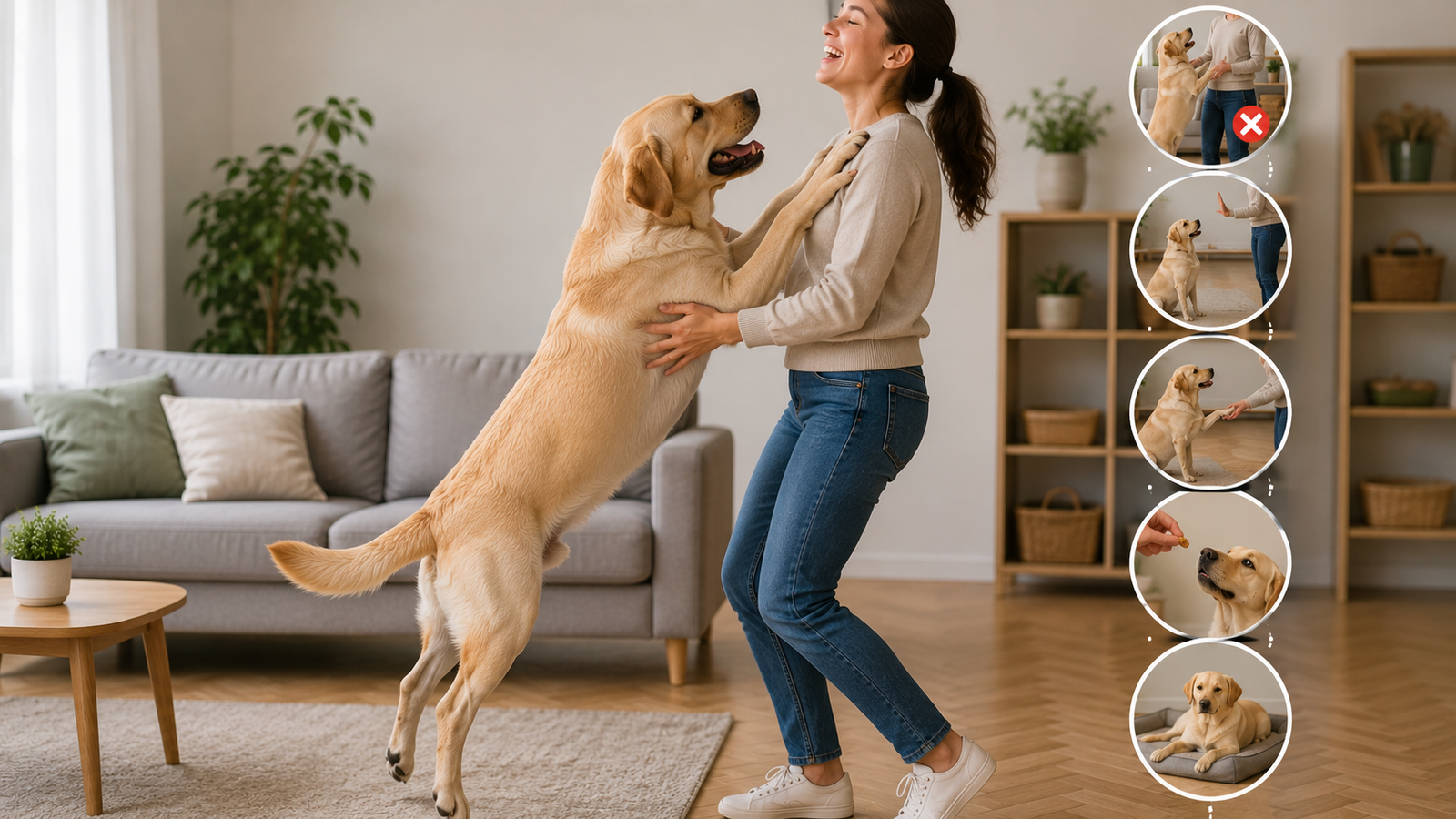
Picture this: the front doorbell rings, or you walk through the threshold after a long, exhausting day at work. Your Labrador Retriever transforms instantly from a sleeping lump on the couch into an airborne missile of pure, unadulterated joy. They launch themselves off the floor, planting their heavy front paws directly into your chest, scratching at your arms, and trying frantically to lick your face.
When they are a fuzzy, fifteen-pound puppy, this behavior is often viewed as endearing. But fast-forward a year. That puppy is now a muscular, seventy-pound powerhouse. Suddenly, those airborne greetings are no longer cute. They are exhausting, stressful, and genuinely dangerous.
You worry about your Lab knocking over elderly family members, scratching young children, or ruining a guest’s clean clothes with muddy paws. You might have tried pushing them away, screaming “No!”, or grabbing their paws, yet nothing seems to work. Every time someone enters the room, the chaotic routine repeats.
If you are currently trapped in this cycle of chaotic greetings, take heart: this behavior can be completely reconditioned.
Labradors do not jump out of dominance or a desire to disrespect you; they do it because they are a highly social, face-oriented breed that has been accidentally trained to believe that jumping works. This comprehensive guide breaks down the biological psychology behind why your Labrador jumps on people and delivers a proven, 5-step positive reinforcement training blueprint to transform your overexcited companion into a model of polite greeting etiquette.
The Canine Psychology: Why Does Your Labrador Jump?
To rewrite your Labrador’s greeting habits, you must first look at the world from their perspective. Dogs communicate using a physical, face-to-face social structure.
1. The Natural Drive for Face-Level Greetings
Since puppyhood, dogs greet one another snout-to-snout. When you walk into a room, you stand several feet above your Labrador’s eye level. Because they desperately want to smell your breath, read your facial expressions, and engage in a natural canine greeting, their immediate instinct is to launch themselves upward to bridge that physical gap.
2. The Trap of Accidental Reinforcement
The primary reason jumping persists into adulthood is that we unwittingly reward it. To a highly social, attention-craving Labrador, any reaction from you is considered a successful reward.
If your Lab jumps on you, and you look at them, push them away with your hands, or yell “Down, down, stop it!”, your dog’s brain processes that interaction as: “Wow, it worked! I launched myself up, and my human looked at me, touched me, and spoke to me!” Even negative attention is better than being ignored. Because the jump successfully bought them attention, they are heavily incentivized to do it again next time.
Why Does Your Labrador Jump on People? 5 Steps to Stop This Habit
This structured behavioral blueprint relies on counter-conditioning—teaching your Labrador an alternative, highly rewarding behavior that is physically incompatible with jumping. A dog cannot launch themselves into the air if they are actively holding a solid, grounded sit position.
The Featured Snippet Answer: To stop your Labrador from jumping on people, you must enforce a strict policy of zero attention for airborne behavior followed by rapid rewards for “four on the floor.” When your dog jumps, immediately cross your arms, turn your back completely, look away, and remain completely silent. The millisecond all four of their paws touch the floor, immediately turn around to reward them with high-value treats and calm affection.
Step 1: Execute the “Total Extinction” Protocol
To eliminate jumping, you must completely remove the payoff. The next time your Labrador launches toward you, you must become a completely boring, unmoving statue.
- Do not make eye contact with your dog.
- Do not touch them or use your hands to push them off your body.
- Do not say “No,” “Off,” or speak to them at all.
- The Action: Fold your arms tightly across your chest, turn your back completely away from their body, and look upward at the ceiling. If they circle around to your front, simply spin your back to them again. By removing all visual, vocal, and physical feedback, you show them that jumping makes you completely vanish.
Step 2: Reward “Four on the Floor” with High-Velocity Timing
Ignoring the bad behavior is only half of the equation; you must rapidly reinforce the correct alternative.
The exact millisecond your Labrador’s front paws touch the ground—even if they just dropped down to prepare for another jump—you must immediately mark that moment. Say a crisp, clear marker word like “Yes!” or click your training clicker, drop down to their level, and deliver a high-value treat (like freeze-dried liver or a small piece of cheese) directly onto the floor.
By placing the treat on the ground rather than feeding them from your raised hand, you visually guide their focus down, reinforcing that good things happen when their feet remain attached to the carpet.
Step 3: Master the “Sit-to-Greet” Default Response
Once your Labrador understands that ignoring them means their paws must stay on the floor, you can elevate the standard by teaching them a default “sit-to-greet” behavior.
- The Routine: Before you open your front door or approach your dog’s space, ask them to “Sit.”
- The Progression: Step toward them slowly. If they stay sitting, praise them calmly and feed them a high-value reward. If their rear end leaves the floor or they tense up to jump, immediately take two steps backward, turn your back, and reset. Do not approach again until their hips are firmly planted back on the floor.
Over time, your Lab will understand a new cause-and-effect rule: Your movement toward me is powered entirely by my hips staying glued to the ground.
Step 4: Use the “Leash Step” Management Tool for Guests
It is relatively easy to control your own body language during a greeting, but controlling your excited guests or visitors is a completely different challenge. Well-meaning friends will often yell, “Oh, it’s okay, I love dogs!” and pet your jumping Lab, completely destroying your hard work.
When guests arrive at your house, put your Labrador on a standard six-foot nylon leash. Before opening the door, drop the leash onto the floor and step firmly onto the middle of the line with your foot.
Adjust your foot placement so your Lab has just enough slack to comfortably stand up, sit down, or lie down, but not enough slack to launch their front chest off the floor. When your guest walks in, if your Lab attempts to jump, they will mechanically hit the short boundary of the leash and stay grounded. This allows you to calmly manage the environment without needing to pull, yank, or scream commands.
Step 5: Harness the “Pre-Emptive Toy Carry” Alternate Focus
Labradors are instinctual, genetic retrievers; their mouths are hardwired to carry items. You can use this inherent breed trait to your advantage to disrupt their overarousal during greetings.
Keep a basket of high-value toys, like heavy rubber Kongs or plush ducks, right next to your front entrance. When you walk through the door, immediately grab a toy and toss it to your Labrador before they can even think about launching into a jump.
Once a Lab has a prized possession clamped securely inside their jaws, their cognitive focus shifts entirely from jumping up to proudly parading around the room to show off their treasure. This simple trick channels their baseline arousal into a quiet, non-destructive outlet.
The Greeting Management Checklist
To help structure your daily management across different visitor environments, utilize this practical tactical operational framework:
| Greeting Scenario | Immediate Management Setup | Target Handler Focus |
| You returning home alone | Completely hands-off, silent entry | Execute Step 1: Ignore until calm “Four on the Floor” occurs. |
| Expected guests at the door | Attach a standard 6-foot leash | Execute Step 4: Step on leash slack to mechanically block air time. |
| Encountering strangers on walks | Create a 5-foot distance buffer | Ask for a default “Sit.” Do not allow greetings if your Lab is pulling or lunging. |
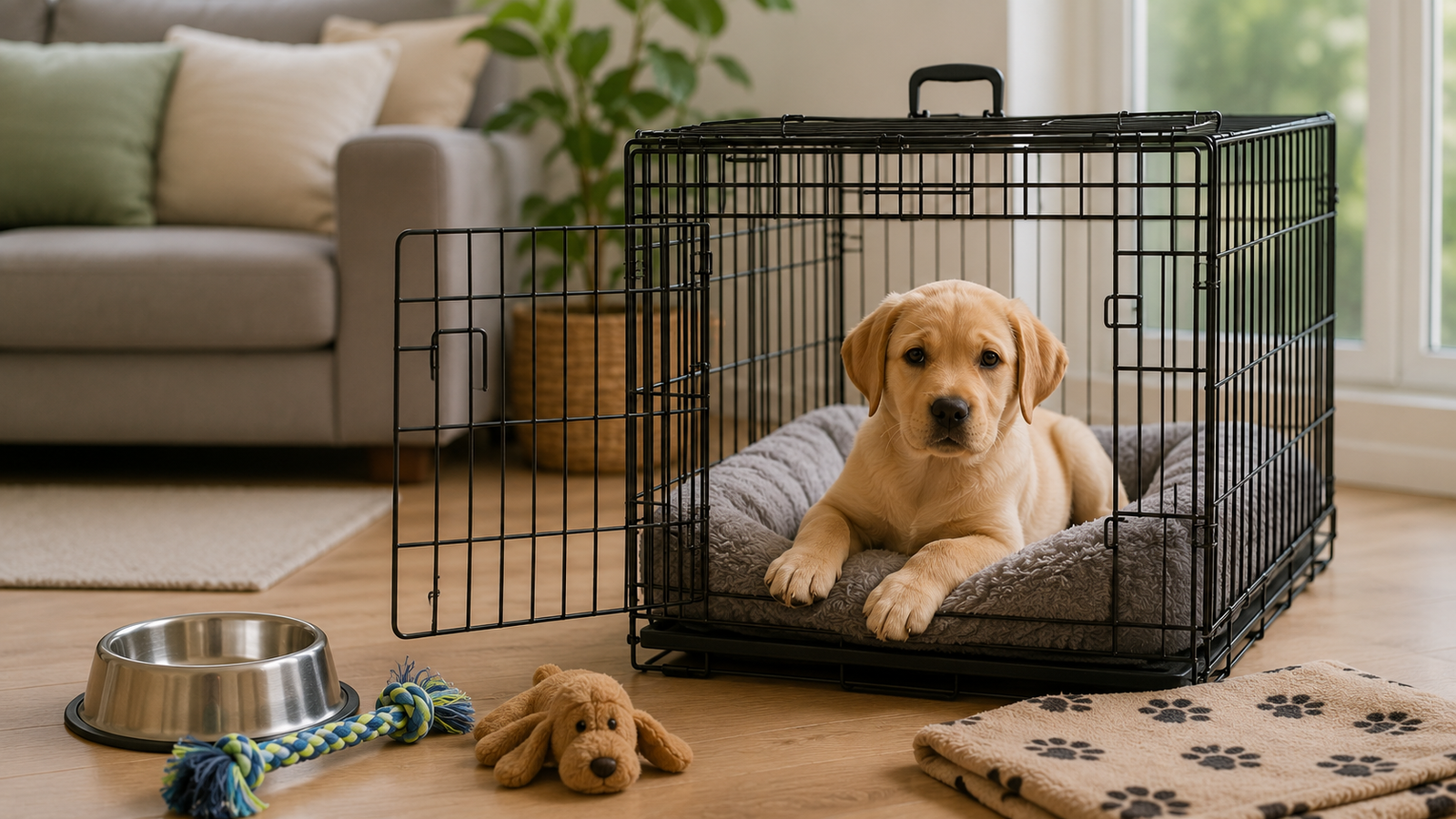
| High-arousal family events | Deploy a frozen puzzle toy | Keep the dog behind a baby gate or in a crate until initial arrival energy settles. |
3 Hidden Mistakes That Prolong Jumping Habits
If you have been working on your dog’s greetings but aren’t seeing steady improvement, make sure you aren’t accidentally making one of these three training errors:
1. Squeezing or Pushing Their Front Paws
An old-school piece of training advice suggested that if a dog jumps on you, you should grab their front paws and squeeze them, or step lightly on their hind toes to teach them a lesson. This approach often backfires terribly with Labradors. To a physical, rough-and-tumble retriever, a physical battle of pushing, grabbing, and shoving feels like an incredible, high-energy game of wrestling. It raises their adrenaline levels and increases their desire to jump back into the action.
2. Allowing Inconsistent Rules
Dogs cannot interpret nuanced situational logic. They cannot understand why it is perfectly okay to jump up and cuddle you when you are wearing your old sweatpants on a casual Sunday morning, but completely unacceptable to jump up when you are wearing a clean suit before heading out to an office meeting. To build a reliable habit fast, the rule must be an absolute constant. Jumping must result in zero attention 100% of the time, regardless of what you are wearing or who is walking through the door.
3. Missing the Internal Arousal Trigger
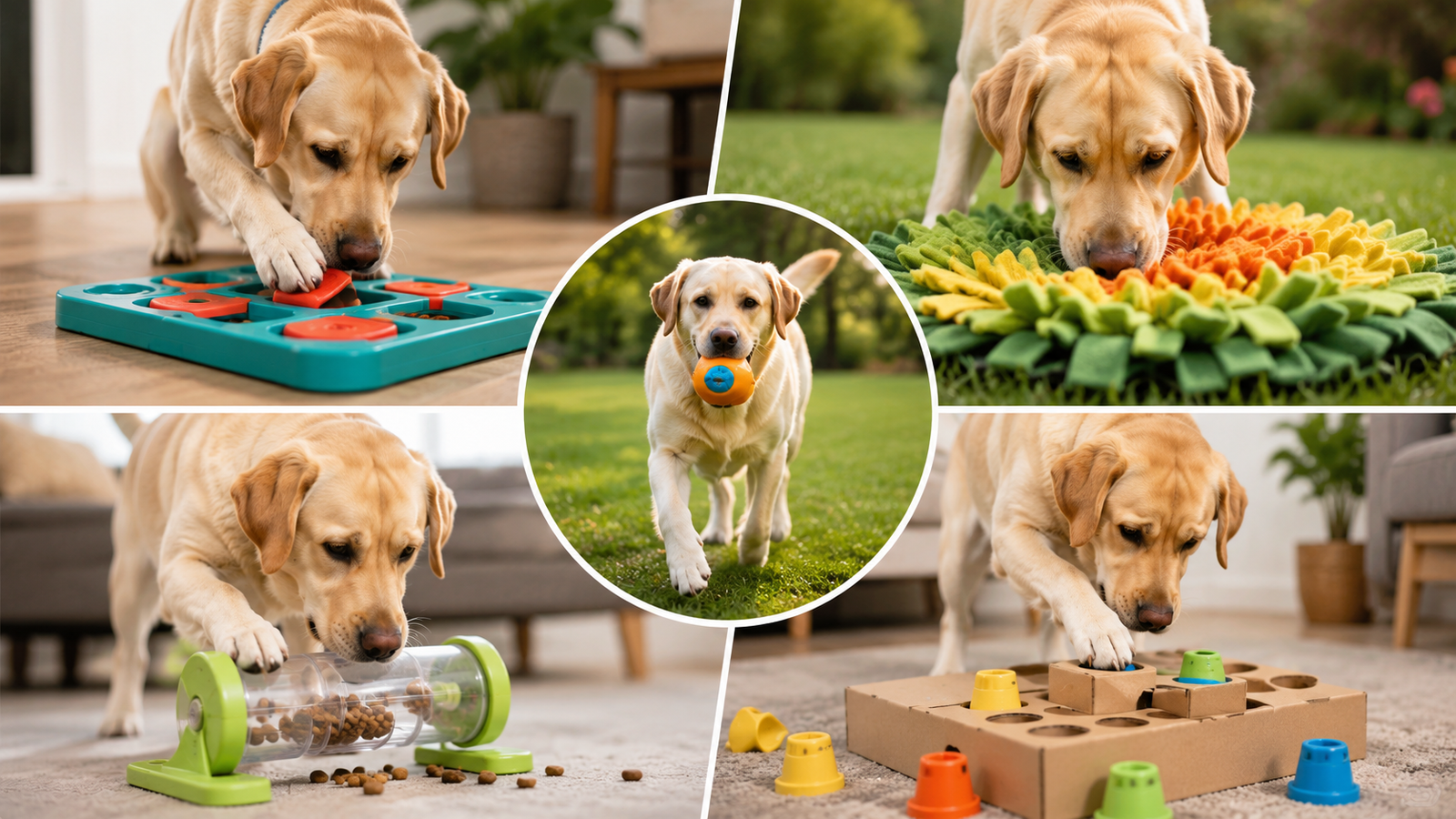
Jumping is simply the outward symptom of an overstimulated mind. If your Labrador receives very little physical exercise or mental stimulation throughout the day, they will store up that pent-up energy like a compressed spring. When the front door finally opens, that spring unleashes all at once. Make sure your adult Lab gets plenty of breed-specific physical exercise, along with daily mental workouts like nose-work games, puzzle feeders, or tracking exercises to keep their baseline arousal manageable.
Frequently Asked Questions (FAQ)
What should I do if my Labrador puppy jumps up and scratches my children?
Because children move quickly, make high-pitched noises, and interact at a dog’s eye level, they are natural targets for overexcited jumping behavior. To protect them, never allow your Labrador puppy to interact with children during high-arousal moments without a leash. Teach your children to practice the “Be a Tree” protocol: whenever the puppy gets too wild or attempts to jump, the child should instantly stop moving, fold their branches (arms) into their chest, and look down at their roots (feet) until an adult steps in to guide the puppy away.
Why does my Lab only jump on guests and never on me anymore?
This is a very common milestone in dog training. It means your Labrador has successfully learned the rules of engagement with you, but they haven’t yet generalized that rule to the rest of the world. In their mind, guests represent a completely different set of possibilities. To fix this, you need to practice your “sit-to-greet” and leash-stepping protocols with multiple friends, neighbors, and family members, teaching your Lab that the exact same rules apply to every human on earth.
How long does it take to completely stop an adult Labrador from jumping?
If every member of your household strictly adheres to the protocol and completely cuts off accidental reinforcement, you will typically see a significant reduction in jumping intensity within two to three weeks. However, completely erasing a long-standing behavioral habit requires consistent management. Expect to actively manage and reinforce polite greetings for roughly two to three months before the behavior transforms into a fully automated, default habit.
Conclusion: Lead with Calmness
An overexcited, jumping Labrador can turn what should be happy reunions into stressful moments of frustration. But remember: your Lab’s jumping isn’t a behavior problem—it’s just a misplaced expression of love and enthusiasm. By applying these five steps, taking away the payoff of accidental attention, and using physical management tools like a leash or a favorite toy, you give your dog a clear, stress-free path to success. Stay consistent, reward the quiet moments, and enjoy the transformation as your airborne companion evolves into a polite, grounded gentleman.
What is your Labrador’s absolute favorite toy to carry around when they are excited, and have you tried the leash-step method yet? Tell us about your training journey or ask your questions in the comments below!