You bring home a brand-new Labrador Retriever puppy, and within 48 hours, reality sets in. That adorable, fluffy ball of joy suddenly transforms into a hyperactive, boundlessly energetic land shark. They sprint down the hallway, leap off the sofa with reckless abandon, and look up at you with eyes that beg for a five-mile run.
As a dedicated owner, your instinct is to tire them out. You lace up your running shoes or grab a tennis ball launcher, determined to run them into a deep sleep.
Stop right there. You could be inadvertently ticking a biological time bomb.
Because Labradors are a large, fast-growing breed, their skeletal system is incredibly fragile during their first year of life. Subjecting a young Lab to high-impact activities, repetitive long-distance walking, or slippery indoor surfaces can cause permanent, irreversible damage to their developing skeletal framework. This structural trauma frequently paves the way for chronic debilitating conditions like hip dysplasia, elbow dysplasia, and arthritis later in life.
The great news is that you do not have to trap your puppy in a crate to protect them. This comprehensive guide outlines the science of canine skeletal development and provides a safe, structured roadmap on how to safely exercise your Labrador puppy without damaging their growing joints.
The Invisible Threat: Understanding Growth Plates and Joint Development
To safely exercise a puppy, you must understand that you are not working with a miniature adult dog. You are exercising an animal whose bones are literally held together by soft, flexible tissue.
What are Growth Plates?
As illustrated in the anatomical forelimb reference above, the long bones in a puppy’s legs grow from specialized, soft areas of cartilage located near the ends of the bones, scientifically termed epiphyseal plates (or growth plates).
- The Soft Zone: These growth plates are highly cellular and soft. They act like architectural scaffolding, constantly manufacturing new bone cells to elongate the limbs.
- The Timeline: In large breeds like Labrador Retrievers, these soft growth plates do not fully calcify and close into solid bone until the puppy is between 12 to 18 months of age.
The Danger of Joint Shearing Forces
Until those growth plates fuse completely, they are the weakest links in your dog’s musculoskeletal structure. If a puppy slips on a slick hardwood floor, jumps out of a high SUV, or undergoes repetitive pounding on hard pavement, those soft cartilaginous zones experience excessive micro-trauma.
This mechanical stress can cause a growth plate to fracture, shift, or close prematurely. If one side of a growth plate stops growing while the other side continues, the leg will grow crookedly, causing structural misalignment at the elbow or hip joint. This misalignment causes uneven wear on cartilage, accelerating the onset of severe canine hip or elbow dysplasia.
The Famous “5-Minute Rule” (And Why It Needs Context)
In the veterinary and breeding communities, the standard baseline for puppy activity is known as the Five-Minute Rule.
The Rule Defined: A puppy should receive a maximum of 5 minutes of structured, leash-based exercise per month of age, up to twice a day.
The Structured Exercise Schedule
To help visualize how this baseline scales as your Labrador puppy matures, reference the standard developmental framework below:
| Puppy Age | Maximum Structured Walk Time (Per Session, Up to 2x Daily) | Approved Activity Type |
| 2 Months | 10 Minutes | Soft grass exploring, basic leash conditioning |
| 4 Months | 20 Minutes | Low-impact walking, basic socialization |
| 6 Months | 30 Minutes | Controlled hiking on natural dirt paths |
| 9 Months | 45 Minutes | Steady walking, controlled swimming introductions |
| 12+ Months | 60+ Minutes | Gradual transition to adult exercise metrics |
Free Play vs. Forced Exercise
The vital nuance that most puppy owners miss is the profound difference between free play and forced exercise.
- Forced Exercise: This includes any activity where the puppy is forced to maintain a consistent speed, direction, or cadence dictated by a human. Walking on a concrete sidewalk on a short leash, running alongside a bicycle, or jogging with an owner are all forms of forced exercise. This is where joint damage occurs.
- Free Play: This includes any activity where the puppy completely controls their own pace, vector, and duration. If your Lab puppy is playing with toys in a grassy yard, they will sprint for thirty seconds, tumble over, sniff a flower, and lie down for a nap when they feel fatigued. Free play is inherently safe because the puppy can instantly self-regulate when their joints ache.
3 Pillars of Safe Labrador Puppy Exercise
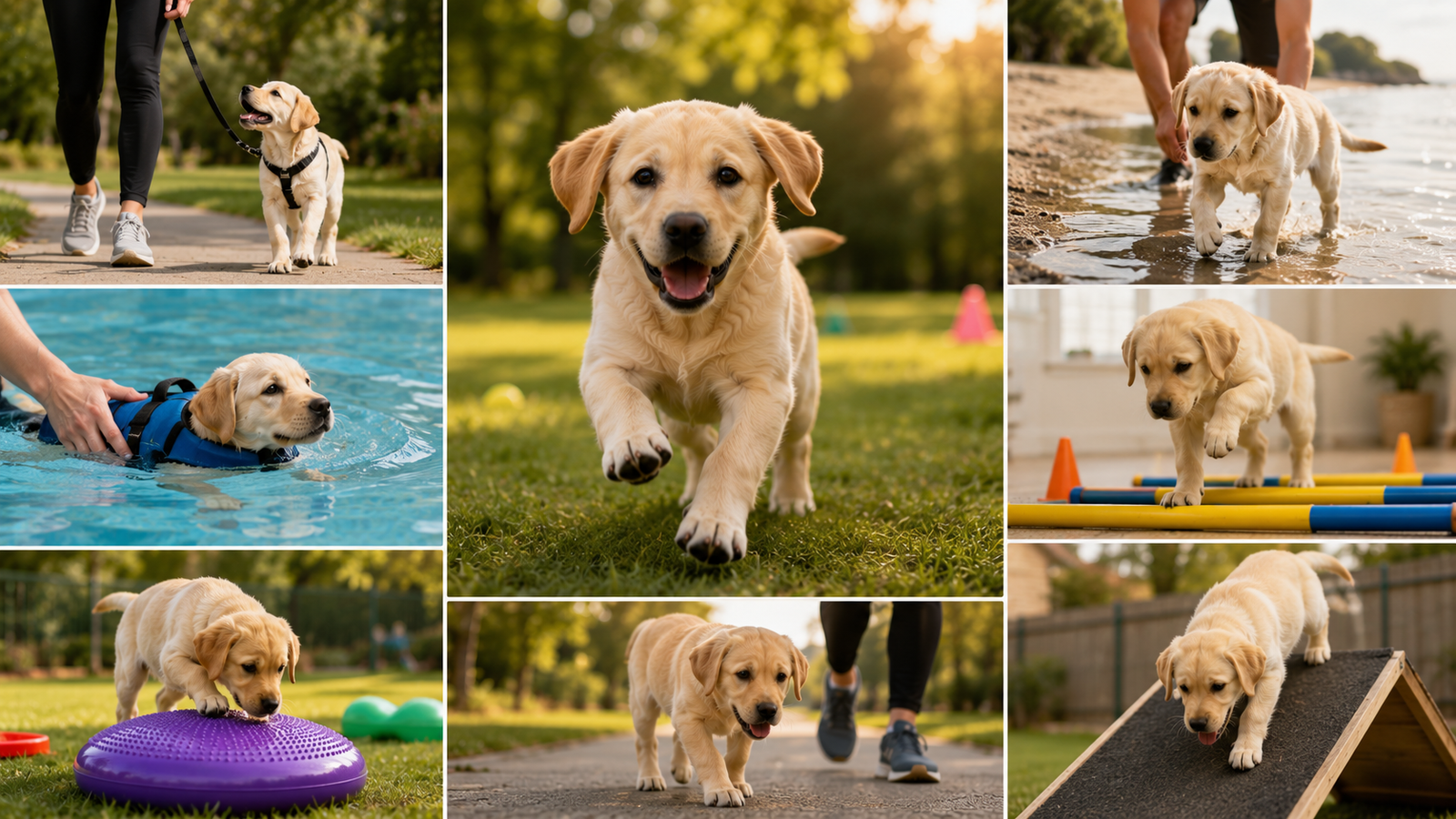
To satisfy your Labrador’s energetic mind without compromising their physical longevity, shift your focus away from physical exhaustion and toward holistic stimulation.
1. Prioritize Low-Impact, High-Traction Surfaces
Whenever your Labrador puppy is executing physical movements, the surface matters immensely. Concrete, asphalt, tile, and hardwood floors are the enemies of growing joints. They provide zero shock absorption and minimal traction, leading to micro-slips that tear developing ligaments.
- The Safe Zone: Seek out soft, forgiving surfaces like natural grass, packed dirt trails, sand, or specialized foam agility matting.
- The Indoor Fix: If your home features slick hardwood or tile floors, lay down inexpensive, rubber-backed area rugs or interlocking foam tiles along your puppy’s high-traffic pathways to prevent dangerous wiping out.
2. Embrace Cognitive Exhaustion (Mental Stimulation)
A Labrador puppy’s brain consumes an immense amount of metabolic energy. If you spend 15 minutes challenging their brain, you will tire them out more effectively than a two-mile run on pavement, with zero joint impact.
- Sniffari Walks: Take your puppy out on a long, loose training line into a field and let them lead with their nose. Allowing a dog to sniff and process environmental scents lowers their heart rate and satisfies their natural hunting instincts.
- Puzzle and Foraging Toys: Feed all of your puppy’s meals through snuffle mats, frozen stuffed rubber toys, or interactive rolling food dispensers. Making them work mentally for their kibble burns off excess chaotic energy safely.
3. Introduce Controlled Low-Impact Swimming
Labradors are genetically engineered for the water. Swimming is an incredible, non-weight-bearing cardiovascular exercise. Because the water buoyancy supports the puppy’s body weight, they can build dense stabilizing muscles around their shoulders and hips without placing any compressive or concussive force on their fragile growth plates.
- The Safety Check: Ensure the entry into the water is a gradual slope rather than a steep drop-off or pool ledge. Avoid letting your puppy jump off docks or steep riverbanks, as the impact of hitting the water can cause joint hyper-extension.
Common Joint Pitfalls to Avoid At All Costs
To ensure your Labrador makes it to adulthood with pristine joints, eliminate these dangerous activities from their daily routine completely:
- The Couch Leap: Do not allow your puppy to jump on or off furniture, beds, or out of vehicles. The downward impact forces up to four times their body weight directly onto their fragile front elbows and wrists. Use pet ramps or physically lift them down.
- The Frisbee Twist: Avoid throwing toys high into the air, forcing the puppy to leap up, twist mid-air, and land heavily on their hind legs. Keep all rolling balls and toys strictly on ground level.
- The Fetch Marathon: Repetitive, hard braking to grab a moving ball causes severe friction inside the shoulder joints. Keep fetch sessions incredibly brief, stopping long before the puppy shows signs of physical slowing.
Frequently Asked Questions (FAQ)
When can I safely start taking my Labrador running or jogging with me?
You should wait until your Labrador Retriever is at least 12 to 15 months old before initiating any structured jogging or running routines on hard pavement. For large male Labs or heavy-boned lines, waiting until 18 months is even safer. Prior to this milestone, your vet can take digital screening X-rays to confirm that the growth plates have completely fused.
My puppy has a massive burst of energy at night (the “zoomies”). Does this mean they need more exercise?
No. The evening “zoomies” (formally known as Frenetic Random Activity Periods, or FRAPs) are almost always a biological sign that your puppy is overtired and overstimulated, not under-exercised. Much like human toddlers who become frantic when they miss a nap, a puppy experiencing the zoomies needs a calm, dark environment or a peaceful crate break to help their nervous system wind down.
If my Labrador puppy limps for a few minutes and then stops, should I be worried?
Yes. Any structural limping, favoring of a leg, or stiffness upon rising should be evaluated by a veterinarian. Do not write it off as simple “growing pains.” Conditions like panosteitis (bone inflammation) or early-onset elbow fragmenting can present as intermittent limping, and early diagnostic intervention is critical to preventing lifelong joint degradation.
Conclusion: Patience Now Saves Pain Later
It can certainly be challenging to manage a high-energy Labrador puppy within the strict boundaries of joint-safe protocols. However, the patience you exercise right now during their first year of life pays massive structural dividends for the next decade. By swapping out intense, high-impact running for brain games, structured grass exploration, and controlled swimming, you protect their growth plates and gift your Lab a strong, pain-free foundation for an active adult life.
Is your Labrador puppy currently exhibiting massive bursts of energy that you are struggling to redirect safely? Describe your puppy’s age and your current daily routine below, and we can craft a personalized, low-impact mental stimulation schedule to keep them calm and structurally sound!