You know you own a Labrador Retriever when your home décor features an uninvited, semi-permanent layer of short, coarse fur. You vacuum on Saturday morning, and by Saturday afternoon, a fresh family of dog hair tumbleweeds is drifting lazily across your hardwood floors.
Because Labradors have a short, smooth exterior profile, many unsuspecting owners assume their grooming needs are practically zero. But beneath that sleek outer layer lies a dense, hyper-productive undercoat designed to repel icy water and trap heat. When that undercoat dies and sheds out, it triggers a literal “fur-nado” in your living space.
If you are using a standard generic slicker brush or, worse, a human hairbrush from your bathroom counter, you are barely scraping the surface. You aren’t removing the dead fur; you are just moving it around while your dog’s skin becomes itchy and suffocated underneath.
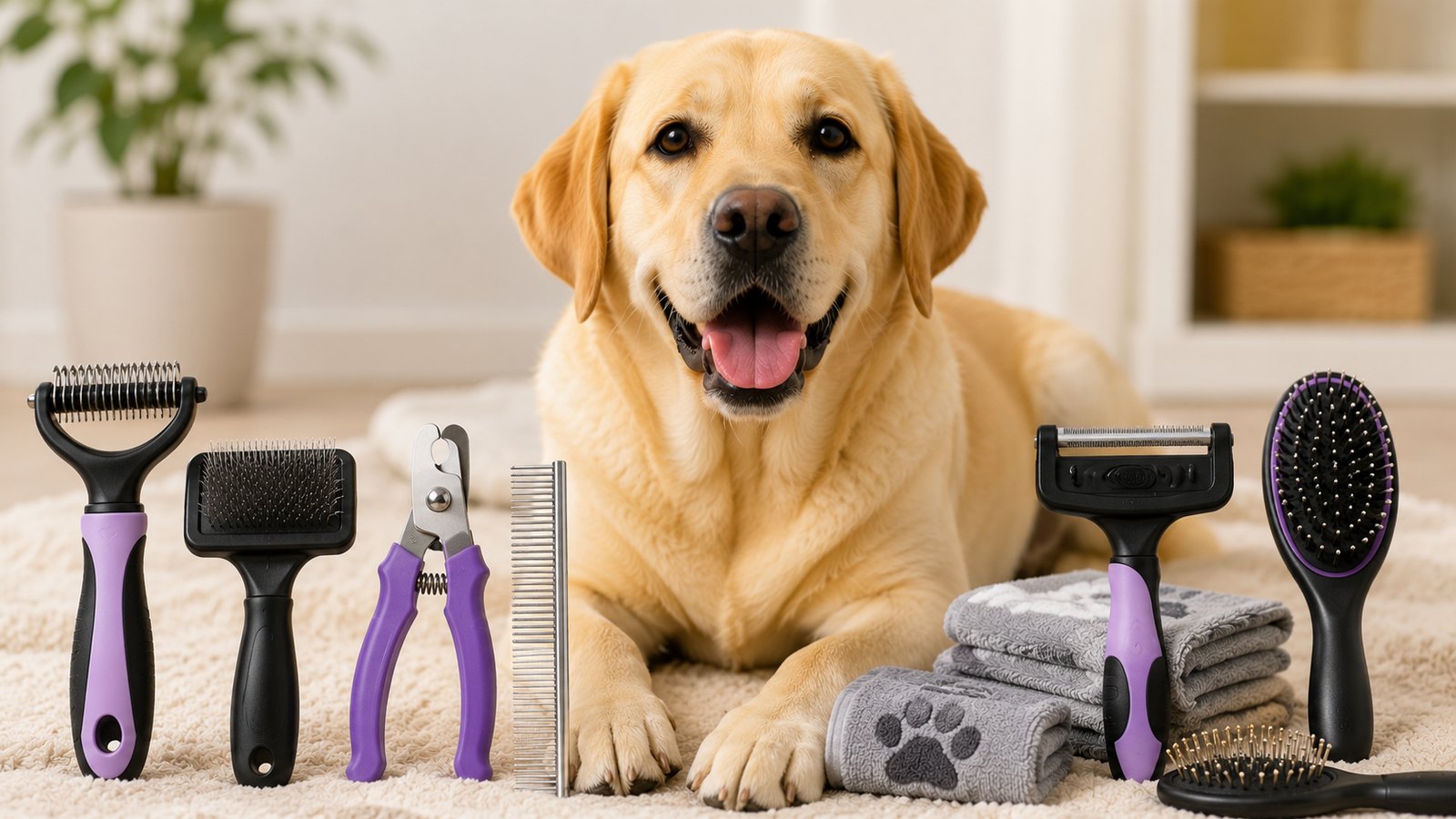
To win the war against the undercoat, you must arm yourself with commercial-grade, breed-specific equipment. This master guide reviews the best grooming tools for Labradors, exposing the elite brushes, de-shedders, nail maintenance systems, and drying blasters that professional groomers use to slash shedding by up to 80%.
1. The Crown Jewels: Best Brushes for Labrador De-Shedding
The absolute core of your Labrador grooming arsenal centers on mechanical hair extraction. Because Labradors are a double-coated breed, a single brush cannot process both layers. You require a multi-tiered approach.
The Undercoat Rake: The Ultimate Deep Extractor
If you can only afford a single tool, make it a high-quality undercoat rake featuring rotating stainless-steel pins.
- Why it works: Unlike standard brushes that scrape the outer guard hairs, the long, rounded tines of an undercoat rake slide right past the topcoat. They reach deep into the subterranean downy layer, hooking onto detached, dead undercoat fibers without cutting or scratching the healthy skin.
- What to buy: Look for dual-row rakes with smooth, rounded tips so there is zero risk of slicing into your Lab’s skin during vigorous grooming sessions.
The Rubber Curry Brush: The Secret Daily Magnet
Often sold under names like the ZoomGroom, a heavy-duty rubber curry brush is the unsung hero of short-coated breeds.
- Why it works: When massaged in circular motions over your Labrador’s coat, the soft rubber teeth generate a micro-static charge that pulls loose, fine surface hairs out like a vacuum magnet. Concurrently, it stimulates the skin’s sebaceous glands, evenly distributing natural conditioning oils across the coat.
- The Bonus: Because it feels like a deep-tissue massage, even the most grooming-phobic Labradors will lean into this tool with joy.
The Dual-Sided Shedding Blade: The Heavy-Duty Stripper
A classic tool borrowed from the equestrian world, the looping stainless-steel shedding blade features coarse teeth on one side and fine teeth on the other.
- Why it works: It is unparalleled for rapidly clearing massive sheets of loose hair during the peak spring and fall “coat blowing” seasons. It can also be unhooked at the handle to form a long, straight metal scraper, which is exceptional for physically pulling water off your Lab’s coat right after a bath.
2. The Game Changer: High-Velocity Drying Blasters
Most pet owners dry their washed Labrador with a bath towel and a standard household hair dryer. This is a massive tactical error. A human hair dryer uses high heat and low airflow, which dries out the canine epidermis, makes the fur brittle, and takes over an hour to process a thick double coat.
Professional groomers rely on a High-Velocity (HV) Forced-Air Dryer.
These heavy-duty machines do not rely on heat to evaporate moisture. Instead, they utilize a powerful motor to blast a highly concentrated, hyper-dense stream of room-temperature air through a narrow nozzle.
When you run an HV dryer over a wet Labrador, the kinetic force literally shears the water directly off the hair shaft while blasting thousands of dead undercoat hairs cleanly out of their follicles. It executes a weeks’ worth of manual brushing in a matter of 15 minutes, safely outside on your patio.
3. Precision Care: Best Tools for Labrador Nails and Ears
Grooming a Labrador goes far beyond managing the fur. Because Labs are heavy, high-impact dogs, neglecting their paws and ears can result in structural orthopedic shifting or agonizing, deep-rooted infections.
Heavy-Duty Scissor Clippers vs. Rotary Dremels
Labradors possess notoriously thick, strong, dark-pigmented nails. If you use flimsy, cheap clippers, the blades will flex, crushing the nail painfully rather than cutting it cleanly.
- The Scissor Clipper Solution: Invest in a heavy-duty, stainless-steel plier-style clipper equipped with a built-in safety guard. The blades must be sharp enough to cleanly sever the nail in a single pass without splitting the outer shell.
- The Rotary Grinder Alternative (The Dremel): Because Labrador nails are dark, it is incredibly difficult to visually locate the quick (the inner blood vessel). A specialized canine rotary grinder allows you to gradually file the nail down molecule by molecule, sealing the blood vessel edges and leaving behind smooth, rounded paws that won’t scratch your hardwood floors.
Veterinary-Grade Ear Flushes
As a water-retrieving breed with heavy, drop-down ear flaps, Labradors are highly prone to trapping moisture inside their unique L-shaped ear canals.
Never use cotton-tipped swabs (Q-tips), which pack wax deeper down. Instead, your ear toolkit must consist of a medicated, drying ear cleanser containing salicylic acid paired with large, sterile cotton balls. Flood the canal, massage the base of the skull, and let your Lab shake the loosened debris safely into the yard.
The Step-by-Step Grooming Tool Sequence
To maximize efficiency and minimize the mess inside your home, always execute your grooming routine using this precise order of operations:
1.The Dry Undercoat Rake Strike:Estimated Time: 10 Minutes.
Run your undercoat rake over the dry dog to break up dense pockets of dead hair before introducing water. Wetting an unbrushed undercoat tightens the dead hair matrices, locking them into the coat.
2.The Anti-Shed Bath and HV Blast:Estimated Time: 15 Minutes.
Wash your Lab with an omega-infused shampoo and heavy conditioner. While the coat is wet, use your high-velocity dryer to blast the moisture and loosened undercoat fur out of the skin.
3.The Rubber Curry Polish:Estimated Time: 5 Minutes.
Once the coat is 100% dry, complete the session by running your rubber curry brush in fluid, circular motions across their body to trap the final remaining surface guard hairs and maximize coat gloss.
Frequently Asked Questions (FAQ)
Is the FURminator safe to use on a Labrador Retriever?
The FURminator de-shedding tool can be highly effective, but it must be used with extreme caution on Labradors. It features a fine, metallic tined blade that can easily cut or damage a healthy topcoat if you apply too much downward pressure or pass over the same patch of skin repeatedly. Limit its use to once every two weeks, and never press hard into the skin.
Why does my Labrador still shed excessively despite daily brushing?
If you are brushing daily and still seeing a massive drop-off, look at their internal nutrition. Brushing can only clear dead hair—it cannot fix weak roots. Ensure your Lab is eating a high-protein diet rich in Omega-3 fatty acids (like salmon oil), which structurally reinforces the hair follicle inside the skin.
How often do I need to grind or clip my Labrador’s nails?
On average, a Labrador’s nails should be trimmed or ground down once every 2 to 3 weeks. A great diagnostic baseline is to listen to your dog walk on a hard surface: if you can hear a distinct click-click-click sound against the floor, their nails are too long and require immediate attention.
Conclusion: Invest in Quality, Enjoy the Results
Trying to manage a shedding Labrador with cheap, subpar grooming tools is an exercise in total frustration. By curating a precise toolkit—consisting of a heavy-duty undercoat rake, a rubber curry brush, and a high-velocity forced-air blaster—you transition from a reactive cleaner to a proactive coat manager.
Not only will your home, clothing, and car seats stay significantly cleaner, but your Labrador will benefit from a lighter, cooler, and immensely more comfortable coat all year round.
Which part of the grooming routine does your Labrador struggle with the most? Let me know your dog’s specific behavioral pain points below, and we can map out a gentle desensitization routine to make grooming completely stress-free!